BLOG
What Is CSMv4: The MOD Cyber Security Model Moves From Its Data to Your Business
Published 7 November 2026 · By P Larner
Regulation & Legislation#DEFCON 658#Cyber Essentials#Cyber Security Model#MOD#CSMv4#defence supply chain#Defence Cyber Certification#Def Stan 05-138
Illustration for: What Is CSMv4, The MOD Cyber Security Model Moves From Its Data to Your Business
Since 2017 the Ministry of Defence has asked its suppliers one narrow question. Can you protect the information we give you? The answer was a questionnaire scoped to wherever MOD Identifiable Information happened to sit, and a well organised supplier could pass it by fencing off one network segment and the dozen people who used it. From 3 December 2025 the question is different. Would your business keep running if someone attacked it? The fence no longer counts, because the thing being assessed is now the whole company, and the standard that defines the controls has deleted the phrase MOD Identifiable Information altogether.
That is the one sentence version of Cyber Security Model version 4, or CSMv4. This post covers what the model is, what changed, what the four levels ask for, how the process runs, and where Defence Cyber Certification fits.
What the Cyber Security Model is
The Cyber Security Model is how the MOD pushes cyber security requirements into its contracts and down the supply chain. It was developed under the Defence Cyber Protection Partnership, a joint MOD and industry initiative whose members include the National Cyber Security Centre and the major primes. It has four moving parts, and most of the confusion about CSMv4 comes from mixing them up.
DEFCON 658 is the contract condition
A DEFCON is a standard defence contract condition, and DEFCON 658, titled Cyber, is the clause that makes everything else enforceable. If it is not in your contract, the rest of this post is good practice rather than obligation.
Def Stan 05-138 is the control standard
Defence Standard 05-138, Cyber Security Standard for Suppliers, lists the controls required at each level of risk. Issue 4 is dated 14 May 2024 and is the version CSMv4 runs on.
The Risk Assessment sets your level
The MOD delivery team, or the prime for a sub-contract, assesses the activity being bought. The output is a Cyber Risk Profile, which fixes the controls, and a Risk Assessment Reference number, which unlocks everything downstream.
The Supplier Assurance Questionnaire is your answer
The supplier self-assesses against the controls for its level in a questionnaire completed in the MOD’s online Supplier Cyber Protection Service. Where the answers fall short, the supplier proposes a Cyber Improvement Plan, which becomes part of the contract.
What version 4 changes
The scope is now your whole organisation
Issue 3 of the standard was about protecting MOD Identifiable Information. Issue 4 states in its scope clause that it covers the supplier’s overarching corporate or enterprise environment, going beyond the information provided for the contract, and its changes table records that MOD Identifiable Information is no longer referenced.
Industry Security Notice 2026/01, dated 30 March 2026, replaces the standard’s covering narrative and makes the point explicit. The requirements apply on a whole of organisation basis to business-critical operations, meaning the activities, systems, assets and processes whose unavailability or compromise would have a material adverse effect on the supplier’s ability to operate. Each organisation is responsible for determining and justifying what those are.
One line in that notice deserves underlining. The assigned level, and not the organisation’s own internal cyber risk assessment, defines the minimum required controls. Your view of your own risk does not reduce the control set. The buyer’s view does.
Four levels replace five profiles
The revision note in Issue 4 records the move from five profiles, Not Applicable, Very Low, Low, Moderate and High, to four levels numbered 0 to 3. The MOD’s guidance is blunt that the old profiles are not consistent with the new levels, so there is no lookup table in which Moderate becomes Level 2. Every existing contract has to be re-assessed.
Level | Name in the standard | Controls | Assessed cyber risk | Certification required |
|---|---|---|---|---|
Level 0 | Basic | 3 | Very low | Cyber Essentials |
Level 1 | Foundational | 101 | Low to moderate | Cyber Essentials |
Level 2 | Advanced | 139 | High | Cyber Essentials Plus |
Level 3 | Expert | 144 | Substantial | Cyber Essentials Plus |
The counts and risk descriptions are those stated in clause 2.2 of Def Stan 05-138 Issue 4. Each level includes everything in the level below it, which the standard confirms by deeming certification at a higher level to satisfy all lower-level requirements.
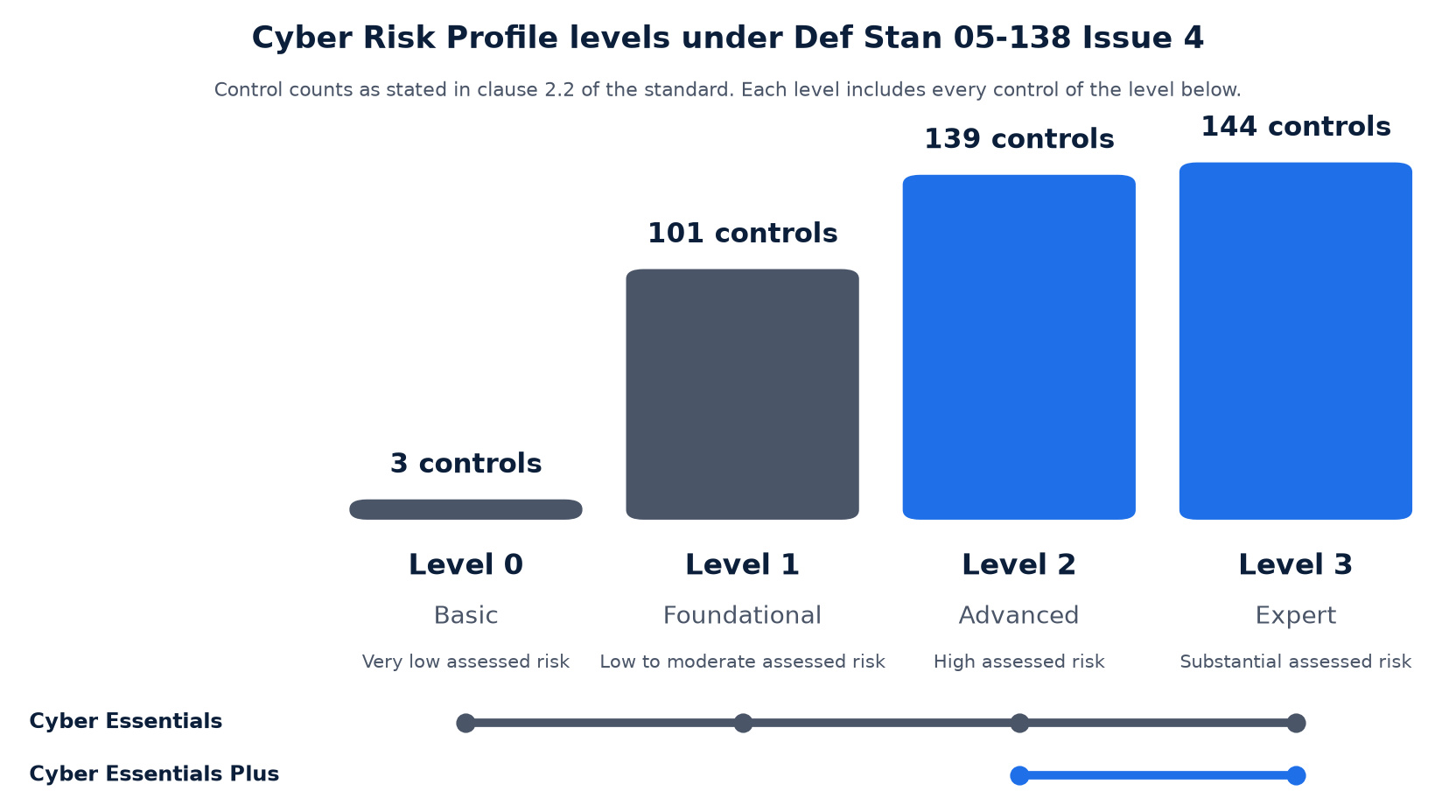
Bar diagram of the four Cyber Risk Profile levels with their control counts and Cyber Essentials requirements
The jump from Level 1 to Level 2 is 38 controls. The jump from Level 2 to Level 3 is five. Level 3 is less a new tier than Level 2 with threat intelligence and more automation.
The control set borrows the Cyber Assessment Framework’s skeleton
The controls sit under four objectives. Objective A is managing security risk, B is protecting against cyber attack, C is detecting cyber security events, and D is minimising the impact of cyber security incidents. Readers of this series will recognise those as the four objectives of the NCSC Cyber Assessment Framework, near enough word for word, although the individual controls are far more prescriptive than the CAF’s outcomes.
Two controls sit above the objectives. Control 0001 requires Cyber Essentials certification covering the scope required for all aspects of the contract, maintained for its duration, at every level including Level 0. Control 0002 requires Cyber Essentials Plus at Levels 2 and 3. Cyber Essentials is the keystone of the whole model.
An online service that scores you on the spot
The Supplier Cyber Protection Service entered public beta on 3 November 2025. The MOD’s guidance states that a questionnaire is automatically scored against the level and the supplier told immediately whether it is compliant. Blank copies of the four question sets were published on gov.uk in March 2026, and they are the best preparation material available.
The annual review is back
The old model had run on an interim process since June 2021, under Industry Security Notice 2021/05, which paused the annual renewal obligation. Industry Security Notice 2025/07, effective from 3 December 2025, revoked the interim arrangements and reinstated the annual review. Suppliers with existing DEFCON 658 contracts are to be notified of their new level and reference before the anniversary, and are told to request one if it has not arrived.
Here the documents disagree, which matters because a missed renewal is a contractual breach. The MOD’s guidance says the new questionnaire is due on the anniversary of contract award, with a one month window after it. The DEFCON 658 text published on gov.uk, Edition 10/22, says the questionnaire must be re-performed at least once in each year of the contract, commencing on the first anniversary of completion of the questionnaire, which is a different date. My advice is to diarise the earlier of the two and treat the one month window as the MOD’s tolerance rather than your target.
The four levels in practice
Level 0 is three controls
The Level 0 question set runs to seven pages and asks three things. Does the organisation hold Cyber Essentials covering the required scope and commit to keeping it? Does it have documented policies and procedures for UK GDPR compliance? Has it assessed how resilient its systems need to be, and built that resilience in? Those are controls 0001, 2314 and 2500 in the standard. It is deliberately achievable, and the MOD’s Director of Cyber Defence and Risk, Eleanor Fairford, wrote in a May 2026 Defence Digital blog post that she has asked all industry partners to achieve Level 0 certification by 31 December 2026.
The catch is the scope of the Cyber Essentials certificate. The control says it must cover the scope required for all aspects of the contract, and the MOD’s Level 0 request speaks of Cyber Essentials for all applicable business-critical systems. A certificate scoped to one office and a handful of laptops will not do.
Level 1 is where the programme starts
Level 1 jumps to 101 controls and a 56 page question set, and it is a full organisational security programme rather than a technical baseline, running from governance and risk management through identity, data and system security to monitoring, incident response and recovery. Some specifics give a feel for the depth. Externally facing systems must be penetration tested at least every 12 months. Logs must be archived for at least 12 months. Email domains must implement DMARC. A supplier whose programme is Cyber Essentials and good intentions should treat the gap as a year’s work rather than a quarter’s.
Levels 2 and 3 add depth rather than breadth
Level 2 adds 38 controls and Level 3 adds five more, and the additions are mostly automation and assurance rather than new domains. Cyber Essentials Plus replaces the self-assessed certificate. Asset inventories must use automated discovery tools. Recovery plans must be tested at least annually, and backups must include secure offsite storage and recovery testing. At Level 3 the standard adds a threat intelligence capability that feeds risk assessment, architecture, monitoring and threat hunting.
How the process runs
The reference number is the key to everything
A Risk Assessment Reference and the required level are provided by the authority at the earliest market engagement, usually in the invitation to tender, and the bidder completes the questionnaire against that reference. Nothing can happen without it, including flow-down to your own sub-contractors. The guidance is explicit that a supplier must first receive a CSMv4 level and reference from its own customer before initiating any flow-down, and that new flow-down under the old interim process is not possible.
The improvement plan is a contract document
A non-compliant supplier must complete a Cyber Improvement Plan setting out when it will meet the required level, or the reasons it cannot. The plan goes in with the tender, the authority weighs it in selection, and the agreed plan is written into the award. But the annual questionnaire tests whether the plan was delivered and the audit clause lets the authority check, so a plan written to get through selection and then forgotten is a breach with a date on it.
Flow-down is the supplier’s job
In the MOD’s own example, prime contractor Company A completes a Risk Assessment for its sub-contractor, passes the generated reference to Company B, which completes the questionnaire for that level, and Company B then runs its own Risk Assessment for Company C. Where B or C fall short, an improvement plan must be agreed between the parties and made visible to the MOD delivery team.
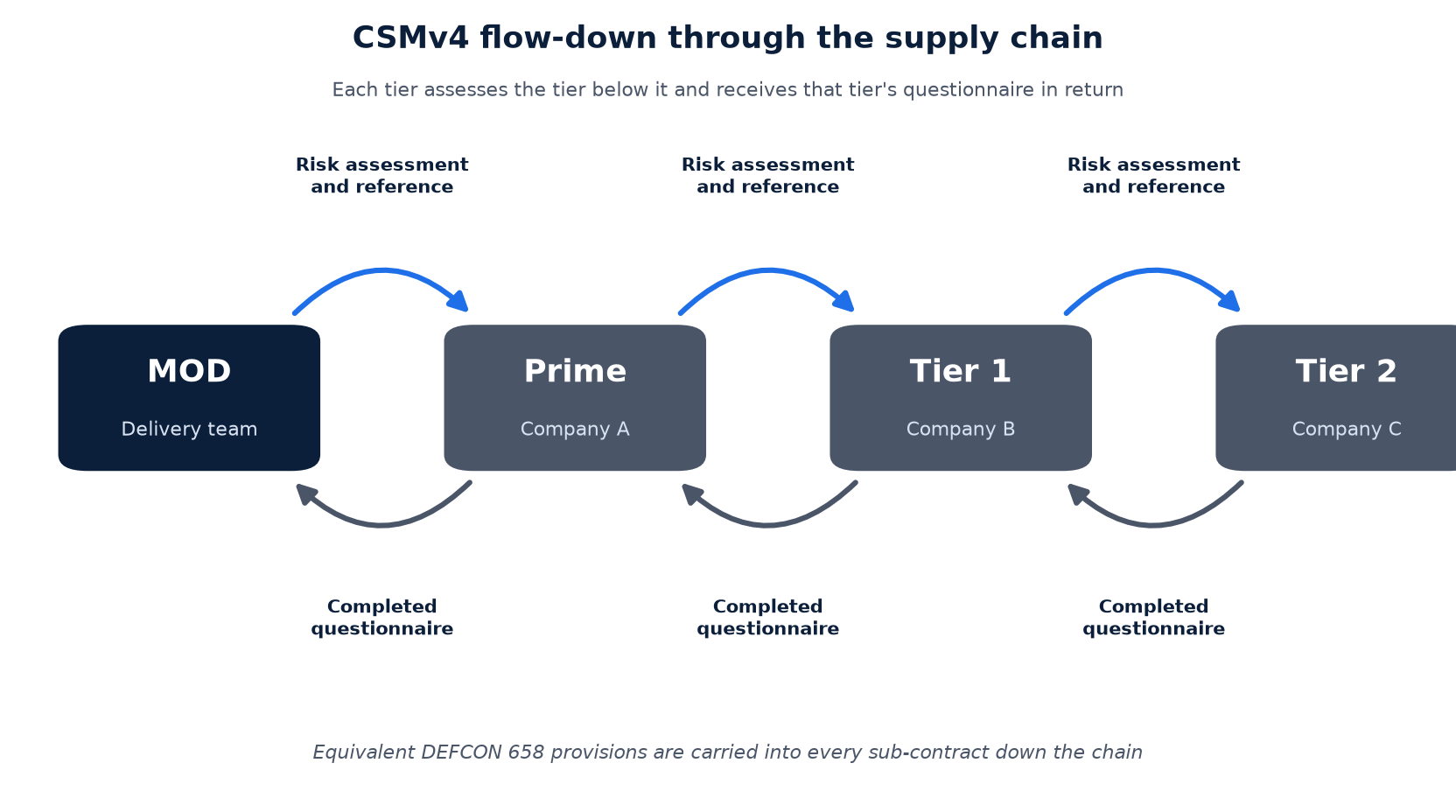
Flow diagram of a four-tier defence supply chain with risk profiles passed down and evidence passed back up
Risk profiles travel down the chain and evidence travels back up it. Each supplier assesses the tier below and carries the condition into its own sub-contracts.
The published flow-down Risk Assessment asks about contract value, the impact if the sub-contractor fails, access to non-public systems, bulk and sensitive data, and non-UK sub-contractors, so a supplier can predict its own level before the reference arrives.
What DEFCON 658 actually binds you to
The edition of DEFCON 658 published on gov.uk is Edition 10/22. Industry Security Notice 2026/01 refers to a 2026 update to the condition, and the current text sits on the MOD’s Knowledge in Defence site behind a defence login, so read the edition in your own contract rather than relying on this summary. On the published text, the contractor and its sub-contractors must do the following.
- Comply with Def Stan 05-138 or the improvement plan attached to the contract.
- Re-perform the questionnaire at least once a year, and again where the supply chain changes or the authority reasonably asks.
- Notify the MOD’s Joint Security Co-ordination Centre warning and reporting point immediately in writing on knowing or believing that a cyber security incident has or may have taken place, with further information in phases.
- Keep records demonstrating compliance for six years after the end of the contract or final payment, whichever is later.
- Submit to audit after an incident, and otherwise not more than once in any calendar year during the contract and for six years after, with the authority endeavouring to give 15 calendar days’ notice.
- Include equivalent provisions in all relevant sub-contracts.
- Accept that the authority may change the standard or the level at its absolute discretion, with any price adjustment claimed under DEFCON 620 by a change proposal within eight weeks.
Two features of the published text are worth noting. The condition lets a prime rely on a sub-contractor’s self-certification where that is reasonable, which is why primes ask so many questions. And it still defines a cyber security incident by reference to MOD Identifiable Information, the very term the standard has dropped. Until the updated condition is published, assume the reporting duty covers any incident touching systems that hold MOD information.
Defence Cyber Certification and where it fits
Self-assessment is the model’s weak point, and the MOD knows it. Defence Cyber Certification is the answer. The scheme launched in May 2025 with IASME as certification authority, and it certifies an organisation against Def Stan 05-138 Issue 4 at one of the four levels. The MOD’s May 2026 blog post describes certification as supported by annual attestation, with full recertification every three years.
Industry Security Notice 2026/02, also dated 30 March 2026, instructs buyers that a supplier holding valid certification at a level equal to or greater than the contract’s level is to be treated as satisfying the control requirement under DEFCON 658. Its equivalence table is simple.
Certification held | Satisfies Level 0 | Satisfies Level 1 | Satisfies Level 2 | Satisfies Level 3 |
|---|---|---|---|---|
DCC Level 0 | Yes | No | No | No |
DCC Level 1 | Yes | Yes | No | No |
DCC Level 2 | Yes | Yes | Yes | No |
DCC Level 3 | Yes | Yes | Yes | Yes |
There is a gap between the notice and the tooling, and suppliers should not fall into it. The MOD’s guidance page, last updated in March 2026, states that suppliers with a valid certificate are not yet exempt from completing the questionnaire through the Supplier Cyber Protection Service, and that the full questionnaire remains mandatory in procurement for now. Certification is assured evidence of compliance. It is not yet a shortcut past the form.
The 2026/01 notice adds that certification applies only to the legal entity assessed, and that the MOD anticipates Level 0 certification becoming a baseline requirement for defence suppliers, which is the formal version of the 31 December 2026 request. The request is not yet a contract term. I do not expect it to stay that way.
The transition traps
Existing contracts need a new reference first
A supplier on a DEFCON 658 contract assessed under version 3 cannot flow anything down until it has a version 4 level and reference from its own customer, and the MOD’s advice is to ask rather than wait. Anything raised under the interim process but not yet advertised in a procurement had to be withdrawn and re-raised from 3 December 2025.
The grace period has two end dates
The 2025/07 and 2026/02 notices both ask MOD project teams to take account of the enhanced resilience requirements during the standard’s first year of operation when setting remediation timescales, and both define that year as financial year 2025/26. The 2026/01 notice, issued the same day as 2026/02, defines it as calendar year 2026. The two readings differ by nine months. Plan for the earlier one and treat the later one as a negotiating position.
The case against, taken seriously
CSMv4 is a better model than the one it replaces, and the criticisms below do not change that. They are the ones I would want a buyer to hear before assigning a level.
Whole of organisation is a heavy ask of a small supplier
A machining firm with 30 staff, one of whom looks after IT, could meet the old model by isolating the drawings it received. Under the new model its finance system, its payroll provider and its production scheduling are all potentially business-critical operations, and at Level 1 it is being asked for 101 controls including annual penetration testing and 12 months of log retention. Whether buyers assign Level 0 and Level 1 with discipline, or default upwards to be safe, will decide whether the model is proportionate in practice, because the supplier cannot argue its way down.
An automatically scored self-assessment is still a self-assessment
Instant scoring is a convenience, not an assurance. The person completing 73 pages of questions at eleven o’clock the night before a tender deadline is under exactly the pressure that produced optimistic answers under version 3. Certification is the real fix, because a certification body looks at evidence, but the tooling does not yet recognise it.
Where to start
- Find out your level. For every live defence contract, ask the delivery team or buyer for the CSMv4 Cyber Risk Profile and Risk Assessment Reference, and note the anniversary date.
- Decide and write down what your business-critical operations are. The justification is the first thing a certification body or auditor will read.
- Run the published question set for your level offline, control by control, and record the evidence behind each answer. The standard requires a documented and implemented control with auditable evidence for every requirement.
- Get Cyber Essentials scoped to the whole business-critical estate, and Plus if you are heading for Level 2 or above.
- Decide on certification. Level 0 by the end of 2026 is the MOD’s stated request. Plan the level above it on the timescale of your most demanding contract rather than your least.
One note on where the evidence lives. The standard requires network diagrams, asset inventories and risk registers, and the questionnaire asks whether you have them, not for them. Those documents are a target map for anyone who wants to attack you, and they belong inside the network they describe. Upload answers, not artefacts.
A decision, not a questionnaire
The old model let a supplier draw a fence around the MOD’s information and call the rest of the business none of the Ministry’s concern. CSMv4 says the rest of the business is precisely the concern, because a supplier that cannot operate cannot deliver, and the defence supply chain is only as resilient as the firm three tiers down that nobody assessed. That is the right instinct, and the mechanics are a reasonable way to act on it.
What the model cannot do is decide for you what is critical, what your evidence looks like, or which level you are building towards. Those are business decisions, and the suppliers who come through this transition well will be the ones who made them deliberately and wrote them down. The fence is gone. What replaces it is your own account of what matters in your business and how it is protected, or a plan with a deadline you are already behind.
Written by P Larner. Drafting and copy-editing were assisted by AI tools, and header images are AI-generated. All technical claims are the author's.
Run your GRC programme in your own network.
RaptorGRC Community Edition is free: every module, offline licence activation, nothing phones home.
Register / Download Contact us