BLOG
What Is SOC 2 and Does a UK Company Need One
Published 23 November 2026 · By P Larner
Frameworks & Standards#trust services criteria#security questionnaires#customer assurance#ISO 27001#AICPA#SOC 2#Type 2 report
Illustration for: What Is SOC 2 and Does a UK Company Need One
SOC 2 is an American assurance report that has become a global expectation in parts of the technology market. This post covers what it actually is, how it differs from ISO 27001, and how a UK company should decide whether it needs one.
What SOC 2 actually is
SOC 2 is a reporting framework from the AICPA, the American professional body for accountants. The reports are examinations of the controls at a service organisation, produced by an independent auditor, and the audience is the service organisation’s customers.
Two things follow immediately and both surprise people.
It is an audit report rather than a certificate. There is no logo you have passed, there is a document containing an auditor’s opinion, a description of your system, the controls you claimed, the tests performed and the results including any exceptions. Customers read it, or they should.
And the controls are yours. Unlike a standard with a fixed control set, SOC 2 asks you to describe the controls you have chosen to meet the criteria, and then tests whether those controls did what you said. Two organisations can both hold clean SOC 2 reports with materially different control sets.
The five trust services categories
The examination covers controls relevant to one or more of five categories, which the AICPA names as security, availability, processing integrity, confidentiality and privacy.
Security is the only one that is effectively mandatory, and it is often called the common criteria. The other four are chosen based on what you are promising customers. A payroll processor might add processing integrity. A hosting provider almost certainly adds availability. A business handling personal data may add confidentiality or privacy.
Adding categories increases cost and scope, so the discipline is to add only what customers actually ask about. Many organisations report on security alone and are perfectly well served.
Type 1 and Type 2
The distinction is the one people get wrong in procurement conversations, and it matters more than the categories.
A Type 1 report describes the controls and assesses whether they are suitably designed at a point in time. It answers the question of whether you have built the right things.
A Type 2 report covers a period, typically somewhere between three and twelve months, and assesses whether the controls also operated effectively throughout that period. It answers whether the things you built actually ran.
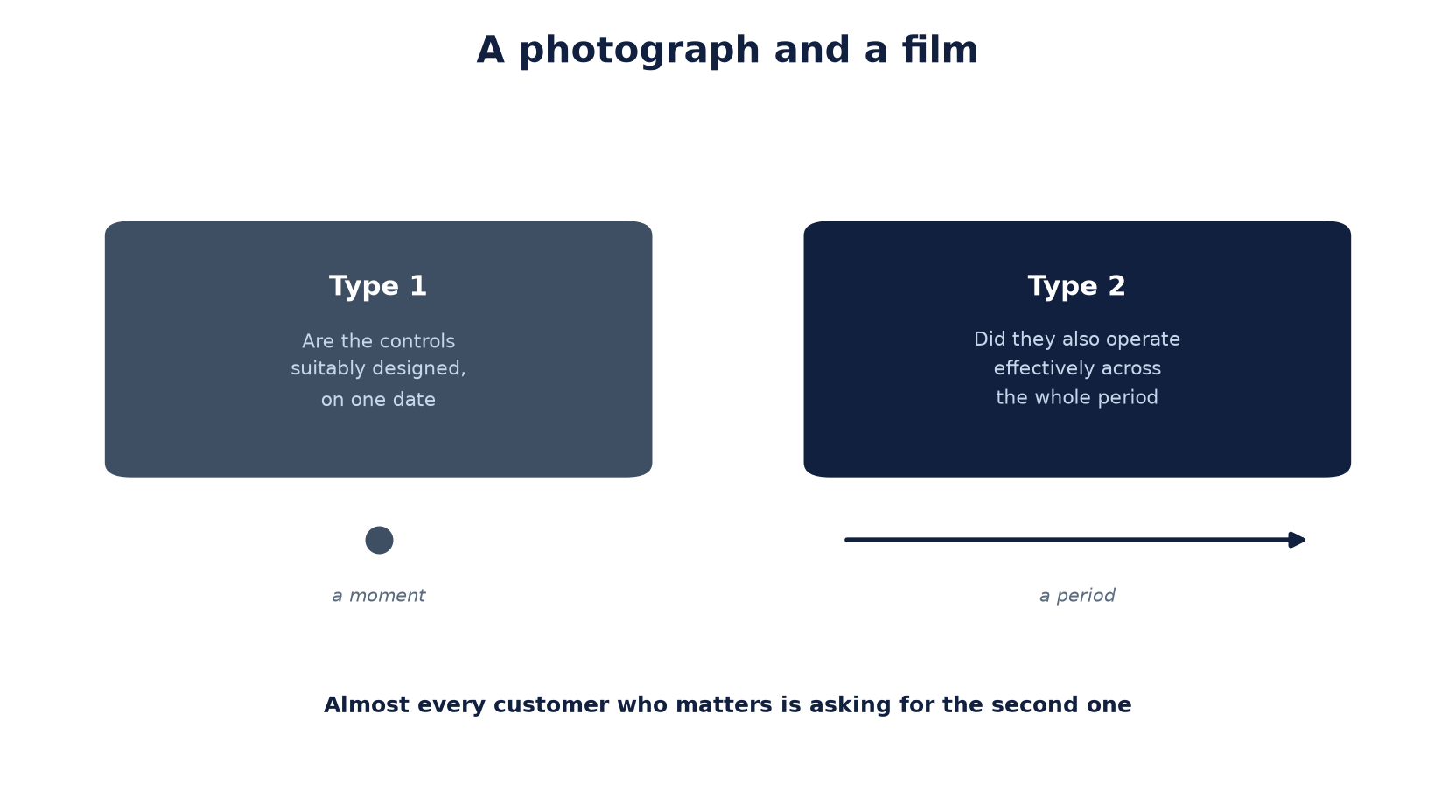
Diagram comparing a Type 1 point in time report with a Type 2 report covering a period
One is a photograph and the other is a film. Almost every customer who matters is asking for the film.
The practical consequence is that a Type 1 is worth considerably less to a sophisticated customer, and is mostly useful as a staging post on the way to a Type 2. If a prospect says they need SOC 2 and you produce a Type 1, expect a follow-up question.
SOC 2 against ISO 27001
The two get treated as alternatives, which is roughly right commercially and quite wrong technically.
SOC 2 | ISO 27001 | |
|---|---|---|
Origin | AICPA, United States | ISO and IEC, international |
Output | An auditor’s report you send to customers | A certificate from an accredited body |
Control set | Yours, mapped to the criteria | Management system clauses, with Annex A as reference |
Who reads it | Customer security and procurement teams, in full | Anybody, at a glance |
Recurrence | A new examination each period | Three year cycle with annual surveillance |
Strongest in | North American technology procurement | UK, European and international procurement |
Says most about | Whether specific controls operated | Whether you run a management system |
The deeper difference is philosophical. ISO 27001 asks whether you have a functioning system for managing information security risk. SOC 2 asks whether the specific controls you told your customers about actually worked. An organisation can hold either without the other, and the mature position for a company selling on both sides of the Atlantic is to build one control set and report it two ways.
Doing both without doing everything twice
The overlap is substantial, commonly cited at well over half the effort. The way to exploit it is to maintain a single control set with a mapping to both frameworks, gather evidence once, and let each report draw from the same well. What does not work is running two programmes with two owners, which is how organisations end up paying twice for one set of controls.
Does a UK company need one
Here is the decision, reduced to its useful form.
You probably need SOC 2 if you sell software or services to North American businesses, particularly technology companies and financial services, and your prospects’ security questionnaires name it. You probably need it if your competitors hold it and you are losing deals at the security review stage.
You probably do not need it if your market is UK and European, where ISO 27001 remains the expected signal and SOC 2 is frequently unfamiliar to the people reviewing your submission. You probably do not need it if you sell to the UK public sector, where Cyber Essentials and other schemes carry the weight.
And you certainly should not obtain one because it seems like the mature thing to do. This is an expensive report with recurring cost, and the only good reason to hold it is that identifiable customers are asking.
Ask your sales team, not your peers
The most reliable input is not benchmarking, it is your own pipeline. Ask sales for every security questionnaire received in the last year and count which frameworks were named. That is a twenty minute exercise and it answers the question better than any amount of industry comparison.
What the process actually involves
Expect a readiness assessment, a remediation period, then the examination itself. For a Type 2 the observation window means you cannot compress the timeline below the period being tested, which is the constraint people discover late.
The evidence burden is continuous rather than episodic, because the auditor is testing that controls operated throughout the window rather than on the day. That is the same discipline an earlier post in this series describes for audit preparation generally, and organisations that already treat evidence as a by-product of the work find SOC 2 far less painful than those that produce it in a sprint.
Budget for the auditor, the readiness work, the tooling you will probably buy to collect evidence, and the internal time, which is usually the largest and least counted line.
The honest counterarguments
It certifies your own homework
There is force in this. You choose the controls, you describe the system, and the auditor tests what you claimed rather than against a fixed external bar. A narrow description with modest controls can yield a clean report. The defence is that the report is readable, and a customer who reads the description and the exceptions can see exactly what was and was not covered. The weakness is real for anyone who only checks that a report exists.
The market treats it as a badge
Widely true, and it undermines the design. Reports get requested, filed and never read, which converts an assurance instrument into a procurement token. That is a criticism of buyers rather than of the framework, and it is the same failure that lets narrowly scoped ISO certificates pass unexamined.
The cost is disproportionate for small companies
Frequently true. For an early stage company the combined cost can be a meaningful share of the year’s spend, and the return is entirely dependent on whether it unlocks revenue. If you cannot name the deals it wins, it is not yet time.
Common mistakes
Scoping the description too widely. Everything in the description is in scope for testing, and organisations routinely describe more of their business than the customer cares about.
Choosing extra trust services categories defensively. Each one adds cost and none of them add value unless a customer asked.
Starting the observation window before the controls are actually operating. Exceptions in the report are permanent, and a rushed start produces a document you will be explaining for a year.
Treating the report as annual paperwork. The controls have to run continuously, and an organisation that relaxes after the examination will produce exceptions in the next one.
Not reading your suppliers’ reports. If you are asking for SOC 2 from others, read the scope, the period, the exceptions and the complementary user entity controls, because that last section lists the things the auditor assumed you were doing.
Where to start
Before anything else, count the questionnaires. If SOC 2 appears in your pipeline repeatedly and ISO 27001 does not, start a readiness assessment. If it is the other way round, spend the money on ISO 27001 and revisit when the pipeline changes.
If both appear, build one control set mapped to both and sequence them, usually ISO 27001 first because the management system discipline makes the SOC 2 evidence gathering considerably easier. What you should not do is what the company in the opening paragraph did, which is to let a single prospect’s request set an eleven month programme without first checking who else was going to ask.
Written by P Larner. Drafting and copy-editing were assisted by AI tools, and header images are AI-generated. All technical claims are the author's.
Run your GRC programme in your own network.
RaptorGRC Community Edition is free: every module, offline licence activation, nothing phones home.
Register / Download Contact us