BLOG
Concentration Risk: When Everyone Depends on the Same Supplier
Published 9 November 2026 · By P Larner
Risk Management#supplier assurance#business continuity#fourth-party risk#risk register#third-party risk#concentration risk#DORA

Illustration for: Concentration Risk, When Everyone Depends on the Same Supplier
Picture a regulated firm with a supplier register of four hundred entries and a rule that no single supplier may hold more than fifteen per cent of any critical service. The register is well kept and the rule is honoured. Then somebody draws the fourth party map and finds that eleven of those suppliers, including both sides of a deliberately split arrangement, run on the same cloud region of the same provider. The rule has been honoured perfectly and the exposure it existed to prevent is entirely intact.
Concentration risk is the exposure that survives good supplier management, because it lives in the relationships between your suppliers rather than in any one of them. This post is about finding it.
What concentration risk actually is
Ordinary third party risk asks what happens if this supplier fails. Concentration risk asks what happens if this one failure takes several things at once.
It shows up in four distinct shapes, and organisations usually only look for the first.
Single supplier concentration, where one provider holds an unhealthy share of your critical services. This is the one every supplier policy already covers.
Fourth party concentration, where several of your suppliers independently depend on the same underlying provider. Your contracts are diversified and your actual dependency is not.
Geographic and infrastructure concentration, where the diversity is real at company level but everything runs in the same region, the same data centre campus, or across the same subsea cable.
Sector concentration, where the whole market has converged on one provider, so your competitors fail at the same moment you do. This one is peculiar because it reduces competitive damage while increasing systemic damage, which is precisely why regulators care about it more than firms do.
Why the register hides it
A supplier register is a list. Concentration lives in the joins, and lists do not have joins.
Three specific features of how registers are maintained make the problem invisible.
Entries are created by procurement events, so the register records who you contracted with rather than who actually performs the service. The subcontractor never appears.
Criticality is assessed per supplier. Two suppliers each rated medium can constitute a single high exposure when they share a dependency, and nothing in a per-row rating surfaces that.
And the register has no field for what a supplier depends on. Even organisations that ask the question in due diligence usually store the answer in a questionnaire response rather than as structured data, which means it cannot be queried across the estate.
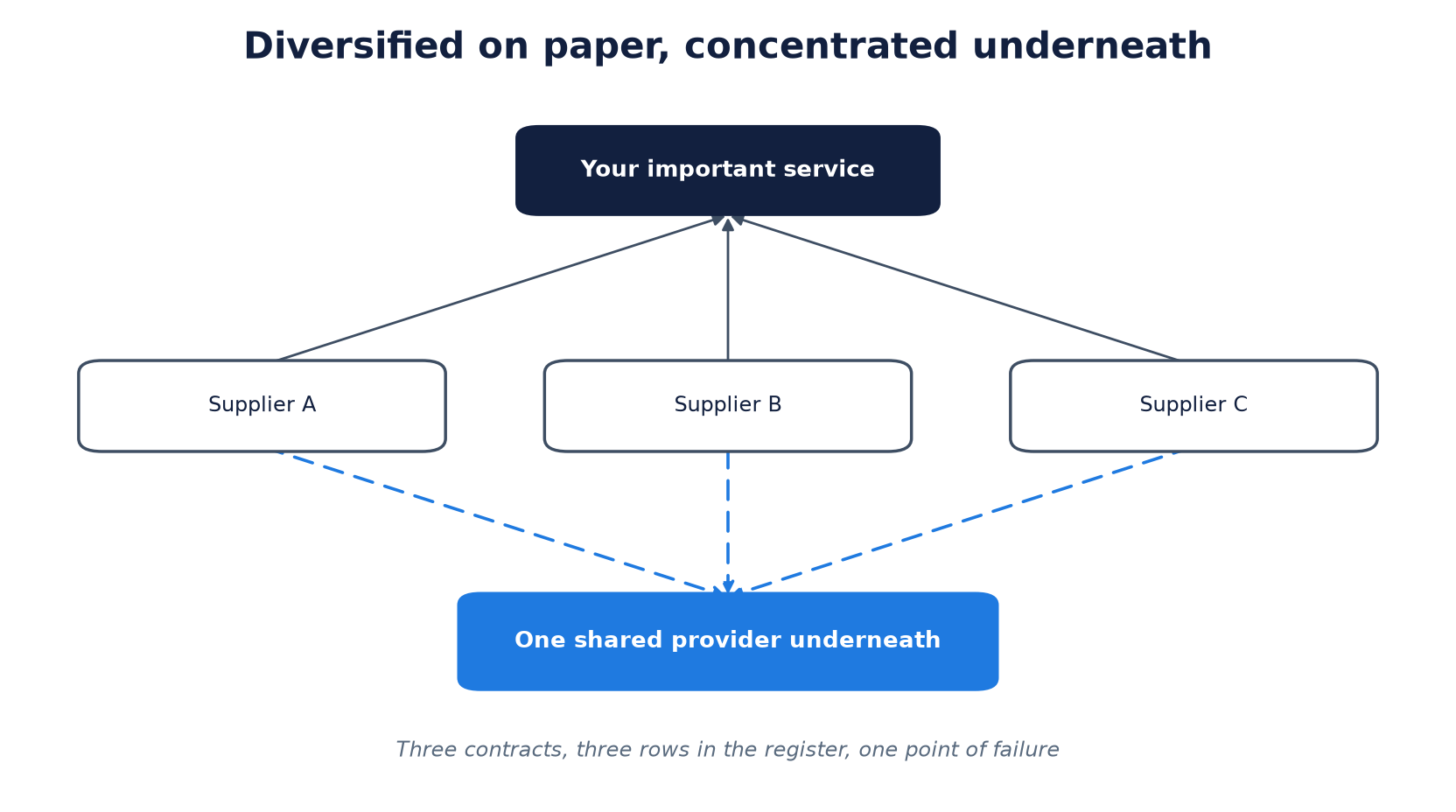
Diagram of several suppliers converging on one shared fourth party
Three contracted suppliers, apparently diversified, resolving to a single underlying provider. The exposure sits at the bottom of the picture and nowhere in the register.
Mapping it without boiling the ocean
Full fourth party mapping across four hundred suppliers is a programme nobody will fund. The tractable version starts from services rather than suppliers.
- List your important business services. Not systems, services, and keep it to the ten or fifteen the organisation could not operate without.
- For each one, write down every supplier involved in delivering it, including the ones procurement classifies as commodity.
- Ask each of those suppliers one question in writing. Which providers do you depend on to deliver this service to us, including hosting, connectivity and any subcontracted operations?
- Put the answers in a column, not a document. The whole value is in being able to sort by it.
- Look for repeats.
Step three is where the work is, and the response rate tells you something in itself. A supplier that cannot name its own critical dependencies within a fortnight has told you about its own continuity maturity, and that is worth recording whatever the answer turns out to be.
What good looks like in the answers
Expect three tiers of quality. Some suppliers will name their hosting provider, their region and their key subcontractors without hesitation, usually because a regulator already made them write it down. Some will name the hosting provider only. Some will treat the question as commercially sensitive, which is occasionally legitimate and more often a sign that nobody has asked before.
For the third group, the fallback is contractual. A right to be informed of material changes in subcontracting is a clause worth more than an answer today, because it keeps working after the map goes stale.
Assessing what you find
Finding a shared dependency is not the same as finding a problem. Concentration is only a risk where the shared thing is both critical and hard to replace.
Question | Why it matters |
|---|---|
How many of our important services touch this provider? | Breadth of the blast radius |
Would they all fail together, or are they in different regions and accounts? | Whether the concentration is real or nominal |
How long could we run without it? | Turns the exposure into your recovery objectives |
Is there a credible alternative, and how long would moving take? | Substitutability, which is the real driver |
Does the provider’s own failure history support our assumptions? | Evidence rather than reputation |
The substitutability question is the one that changes decisions. A shared dependency on a commodity service with three interchangeable competitors is a manageable exposure. A shared dependency on a provider whose replacement would take eighteen months and a rewrite is a strategic position, and it should be owned at board level rather than in a supplier register.
What you can actually do about it
The honest answer is that most concentration cannot be engineered away at acceptable cost, and pretending otherwise produces expensive theatre. The realistic options are narrower and more useful.
Accept it explicitly. A documented, owned, board-level acceptance with a review date is a legitimate outcome and a far better position than an undocumented dependency nobody has noticed. This series keeps returning to the same theme, which is that a deliberate decision beats an accidental default.
Reduce the blast radius rather than the dependency. Different regions, separate accounts, independent credentials and separate failure domains do not remove the provider but they remove the single simultaneous failure, and they are usually achievable inside existing contracts.
Buy time instead of alternatives. Extended notice periods, escrow, exit assistance clauses and pre-agreed transition support convert a cliff edge into a runway. This is what most exit planning actually delivers in practice.
Diversify where the market genuinely allows it, and be honest about where it does not. Splitting between two providers who both run on the same underlying infrastructure buys contract diversity and no resilience at all.
Where the regulators have got to
Financial services has been ahead here for years, because the sector recognised early that outsourcing had concentrated operational risk into a handful of technology providers. DORA in the EU addresses it directly through the register of information and the oversight of critical third-party providers, and the UK’s critical third parties regime does something structurally similar. Earlier posts in this series cover both.
If you are outside financial services, the useful takeaway is not the regulation, it is the diagnosis. Regulators arrived at concentration risk by watching the same thing happen repeatedly, and the exposure exists in your sector too, without the supervisory apparatus that makes somebody look at it.
The honest counterarguments
The big providers are more reliable than anything you would build
Broadly true, and it is the strongest argument against acting on concentration at all. Major providers have better engineering, better redundancy and better staff than almost any customer. The counter is that concentration risk is not a claim that the provider is unreliable, it is a claim about correlation. A provider with a very low failure rate that takes eleven of your suppliers down simultaneously when it does fail is a different risk shape from eleven independent suppliers with higher individual failure rates.
Mapping goes stale immediately
It does. Suppliers change subcontractors without telling you, and a map built this quarter is wrong by the next. The answer is to map only the important services, refresh on a defined trigger rather than continuously, and rely on contractual notification for the rest. An imperfect map that exists beats a perfect one that was never started.
There is nothing you would actually do differently
Sometimes true, and worth admitting. If the answer to every option is that you would accept it anyway, the exercise has still produced something valuable, which is a documented acceptance rather than an unexamined assumption. What it must not produce is a map that goes into a drawer while everybody feels better.
Common mistakes
Treating diversification as achieved because two contracts exist. Contract count is not dependency count, and the fourth party map is the only thing that tells you which you have.
Assessing concentration only for technology. Single points of failure appear in specialist professional services, in logistics, in a sole certification body and in the one contractor who understands the plant. The technology examples are simply easier to see.
Leaving it with procurement. Procurement owns the contracts and cannot see the architecture. Architecture can see the dependencies and does not see the contracts. Concentration analysis needs both in the same room, which is why it usually happens nowhere.
Confusing it with vendor lock-in. Lock-in is a commercial problem about switching cost. Concentration is a resilience problem about simultaneous failure. They often coexist and they need different treatments.
Where to start this quarter
Take your three most important services and ask, for each supplier involved, who they depend on. That is perhaps a dozen emails. Put the answers in a spreadsheet column and sort it.
If a name appears more than twice, you have found something the register could never have shown you. Write it up as a single risk with a named owner, an honest assessment of how long you could run without it, and a recommendation that is either mitigation or explicit acceptance. That one entry is worth more than a fourth party mapping programme you will never finish, and it usually starts the conversation that funds the rest.
Written by P Larner. Drafting and copy-editing were assisted by AI tools, and header images are AI-generated. All technical claims are the author's.
Run your GRC programme in your own network.
RaptorGRC Community Edition is free: every module, offline licence activation, nothing phones home.
Register / Download Contact us