BLOG
The Risk and Control Self Assessment, Done Honestly
Published 13 November 2026 · By P Larner
Risk Management#control effectiveness#risk culture#risk register#second line#internal audit#control testing#RCSA

Illustration for: The Risk and Control Self Assessment, Done Honestly
A risk and control self assessment is a peculiar instrument. You ask a team to grade its own controls, in writing, knowing the grades go upwards to people who decide budgets and bonuses. Then you are surprised when almost everything comes back green.
The self assessment is not broken by dishonest people. It is broken by a design that makes honesty expensive and optimism free. Fix the incentives and the instrument becomes one of the most efficient sources of risk information an organisation has, because the people closest to the work genuinely do know where it is weak.
What an RCSA is for
The purpose is to get the assessment of a control from the people who operate it, at a frequency no independent function could afford. Internal audit might reach a process every three years. The team running it touches it daily.
That trade is the whole point. You are exchanging independence for coverage and currency. An RCSA is not an audit and should never be presented as one, because the moment it is treated as assurance the incentive to grade honestly disappears entirely.
Two outputs matter. A current view of which controls are working, and a list of the ones that are not, owned by people who can do something about it. Anything else the process produces is administration.
Why everything comes back green
Understanding the failure mode is most of the fix.
Grading your own work is uncomfortable, and the discomfort is not evenly distributed. A green rating requires no explanation, no action plan and no follow-up conversation. An amber rating generates a meeting, a remediation plan and a recurring item on somebody’s list. The cost asymmetry is enormous and entirely one directional.
Ratings are also read as performance. When the same grid appears in an operations review beside delivery metrics, people quite reasonably infer that red reflects on them rather than on the control. Nothing in the design contradicts that inference.
And the scales are usually undefined. “Effective” means whatever the assessor thinks it means, which in practice means the control exists and nothing has gone wrong recently. Absence of incident is not evidence of control effectiveness, but it is the evidence everyone reaches for.
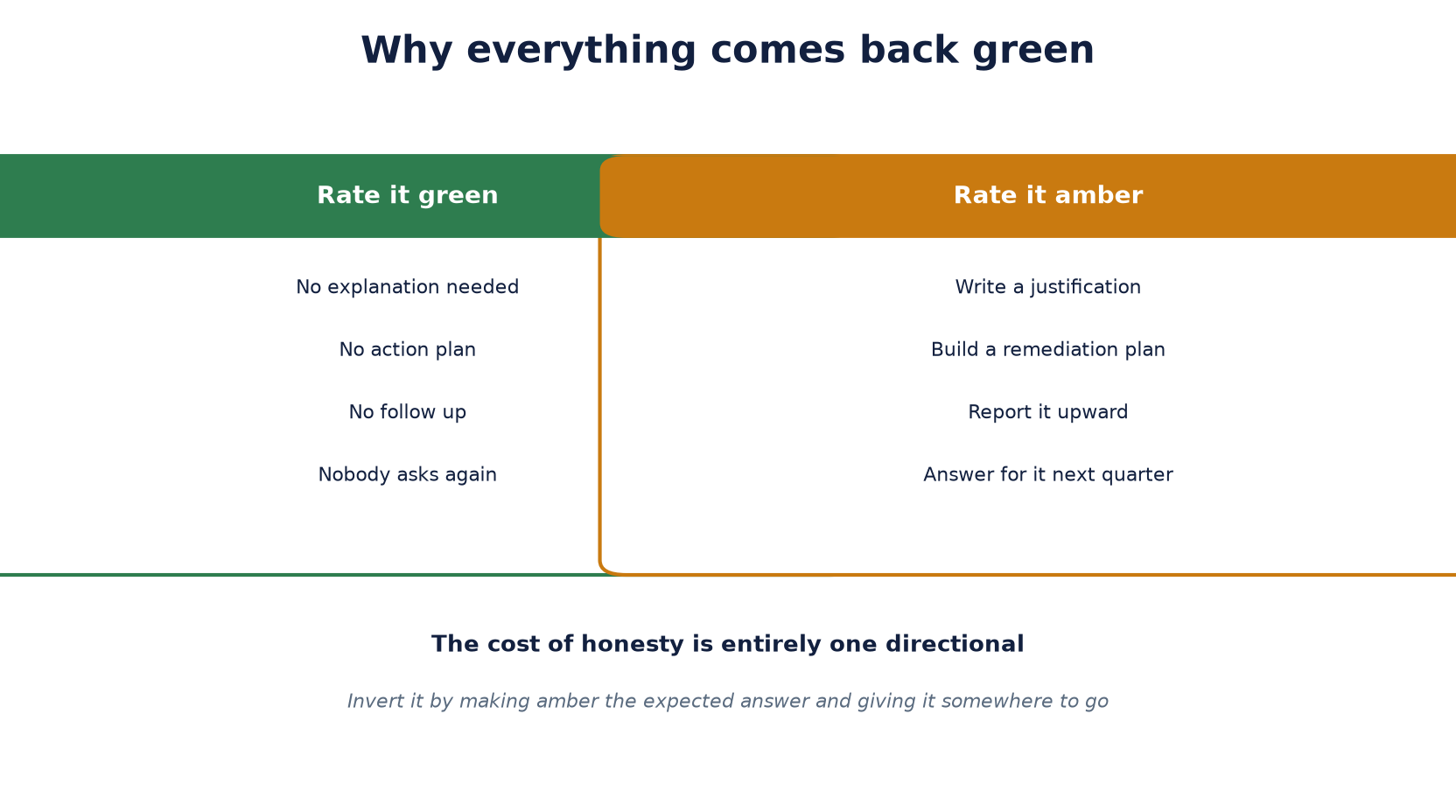
Diagram contrasting the effort of a green rating against an amber rating
The two ratings cost wildly different amounts of work, and nothing in the standard design corrects for it.
Design the incentives before the template
Four design decisions determine whether you get honest data, and none of them are about the form.
Separate the control rating from the person
Rate the control, publicly, and keep the individual out of it. That means never presenting RCSA results alongside individual or team performance measures, and saying so explicitly when the process launches. Managers will not believe it the first cycle. They will believe it the second cycle if it turns out to be true.
Make amber the expected answer
If your distribution is ninety per cent green, the scale is wrong or the process is theatre. Say at the outset that a healthy assessment across a real organisation produces a substantial amber population, and that a team returning all green will be asked more questions than a team returning some ambers. That single framing inverts the cost asymmetry.
Reward the finding, not the grade
The behaviour you want is disclosure. Recognise the teams who surface problems, in the same forum where results are discussed, and do it visibly. This sounds soft and it is arguably the most effective single intervention available, because it changes what people think the process is for.
Give amber somewhere to go
Honesty has to be affordable. If every amber requires the team to fix it from its own budget within the quarter, teams will not declare ambers. There must be a route where a declared weakness becomes an organisational risk with a funding conversation rather than a local problem with a deadline.
Write scales somebody can apply
Vague scales produce vague answers. The strongest RCSA designs replace adjectives with evidence questions.
Rating | The question that decides it |
|---|---|
Effective | The control operated as designed every time in the period, and I can show you the evidence |
Partially effective | The control operated, with known exceptions or gaps I can describe |
Ineffective | The control did not operate reliably, or we cannot demonstrate that it did |
Not applicable | The risk this control addresses no longer exists here, and here is why |
The phrase doing the work is “I can show you the evidence”. It converts the question from an opinion about quality into a factual question about whether the evidence exists, which is far harder to answer optimistically and far easier to check.
Note that the last row matters more than people expect. Without a clean way to say a control is no longer relevant, teams keep rating obsolete controls green forever, and the assessment slowly fills with fiction.
Sampling beats completeness
An RCSA covering four hundred controls annually is a data entry exercise. Nobody thinks hard about entry three hundred, and the quality of the whole set degrades to the quality of its most tired hour.
Better designs assess a subset properly. Every control gets assessed on a cycle, the critical ones every quarter and the rest annually, and each assessment asks for evidence rather than a rating alone. Fifty considered assessments beat four hundred reflexive ones, and the difference is visible immediately in how many ambers appear.
Validation is what makes it credible
Self assessment without any verification is opinion collection. The fix is not to verify everything, which would cost more than the process saves, but to verify enough that the answers stay honest.
A workable model takes a small random sample each cycle, perhaps one in ten, and has second line or internal audit test the evidence behind the rating. Two things then happen. Where the ratings hold up, the whole set gains credibility that it could not earn on its own. Where they do not, you have learned something more valuable than the rating, which is that this area’s self assessment cannot be relied on.
Publish the validation result alongside the assessment. An organisation that says its self assessment was sampled and agreed in eight cases out of ten is making a far stronger claim than one presenting an unvalidated wall of green.
Connecting it to the register
An RCSA that terminates in its own spreadsheet has wasted the hardest part, which is getting people to admit a weakness.
Every ineffective and partially effective rating should produce one of three outcomes. A remediation action with an owner and a date. A risk register entry where the fix is expensive or slow, so the exposure is visible to whoever accepts it. Or a documented decision that the weakness is tolerable, with a review date.
What must not happen is the fourth outcome, which is an amber that is recorded, reported, discussed and then carried unchanged into the next cycle. Nothing teaches an organisation to stop declaring ambers faster than watching the last set achieve nothing.
The honest counterarguments
Self assessment is inherently unreliable
The criticism is fair and it is why the model needs validation and why the output should never be labelled assurance. The defence is coverage. Independent testing of every control at a useful frequency is unaffordable for almost every organisation, so the real choice is not between self assessment and audit, it is between self assessment and no current view at all.
It generates enormous administrative effort for modest insight
True of badly designed schemes, which is most of them. The effort scales with the number of controls assessed and the insight scales with the honesty of the answers, so the fix is fewer controls assessed more carefully. If your RCSA takes a team a full day per cycle and produces no ambers, you are paying a real cost for a result you could have written in advance.
Teams will simply learn to give the answers that avoid attention
This is the most serious objection because it can defeat every countermeasure. If the surrounding culture punishes bad news, no template design will fix it, and the RCSA will faithfully report the culture rather than the controls. Where that is the case, the honest thing is to say so rather than to keep collecting the data and treating it as real.
Common mistakes
Running it as a compliance obligation. Teams can tell the difference between a process that wants information and one that wants a completed form, and they respond accordingly.
Aggregating too early. A departmental average hides the two ineffective controls that matter, and averages of ordinal ratings are meaningless in the same way that multiplying risk matrix scores is.
Assessing design and operation together. A control can be well designed and poorly operated, or the reverse, and the treatments are completely different. Ask both questions separately.
No memory between cycles. Without last period’s rating beside this one, nobody notices the control that has been amber for two years, which is precisely the signal the process exists to produce.
Letting the risk function grade on behalf of the team. It is faster, it produces better looking output, and it destroys the only thing the instrument was for.
Where to start
Take one department and twenty controls, not the whole estate. Rewrite the rating scale around evidence rather than adjectives. Tell that department, in writing and in person, that ambers are expected and that declaring one will not be held against them.
Then run one cycle, sample three ratings for validation, and look at the distribution. If ambers appear and a couple of them turn into funded actions, you have a working instrument and can scale it. If everything comes back green again, the problem is not the template, and the next conversation is about the culture rather than the form.
Written by P Larner. Drafting and copy-editing were assisted by AI tools, and header images are AI-generated. All technical claims are the author's.
Run your GRC programme in your own network.
RaptorGRC Community Edition is free: every module, offline licence activation, nothing phones home.
Register / Download Contact us