BLOG
What Is Cyber Essentials and What Does Plus Actually Add
Published 6 November 2026 · By P Larner
Compliance in Practice#Cyber Essentials Plus#Cyber Essentials#NCSC#IASME#certification#patching

Illustration for: What Is Cyber Essentials and What Does Plus Actually Add
Somewhere in your sales team’s shared drive there is a tender response with a Cyber Essentials logo on it. Somewhere in your IT team there is a person who filled in the question set at eleven o’clock the night before the deadline, ticked yes to a question about mobile device management, and has been quietly hoping nobody follows up. Both of those things are extremely common, and only one of them is a security control.
Cyber Essentials is the most widely held security certification in the UK and the most widely misunderstood. This post covers what it actually requires, what the Plus variant genuinely adds, where the scheme quietly fails larger organisations, and how to decide which one you need.
What the scheme actually is
Cyber Essentials is the minimum standard of cyber security recommended by the UK Government for organisations of all sizes. It was developed by the NCSC, and it is delivered through IASME as the official Delivery Partner, which manages a network of certification bodies across the UK.
The scheme is deliberately narrow. It targets the most common internet-based threats, which the NCSC characterises as the digital equivalent of a thief trying your front door to see whether it is unlocked. It is not attempting to defend you against a determined and well resourced adversary, and it does not pretend to. That narrowness is the source of both its value and most of the criticism aimed at it.
Two things follow from that design. It is achievable for a small organisation without consultants, which is the point. And it says almost nothing about governance, risk management, supplier assurance or incident response, which is why it sits underneath rather than alongside something like ISO 27001.
The five technical controls
Everything in the scheme reduces to five controls. They are worth reading as the NCSC words them, because the wording is broader than most people assume.
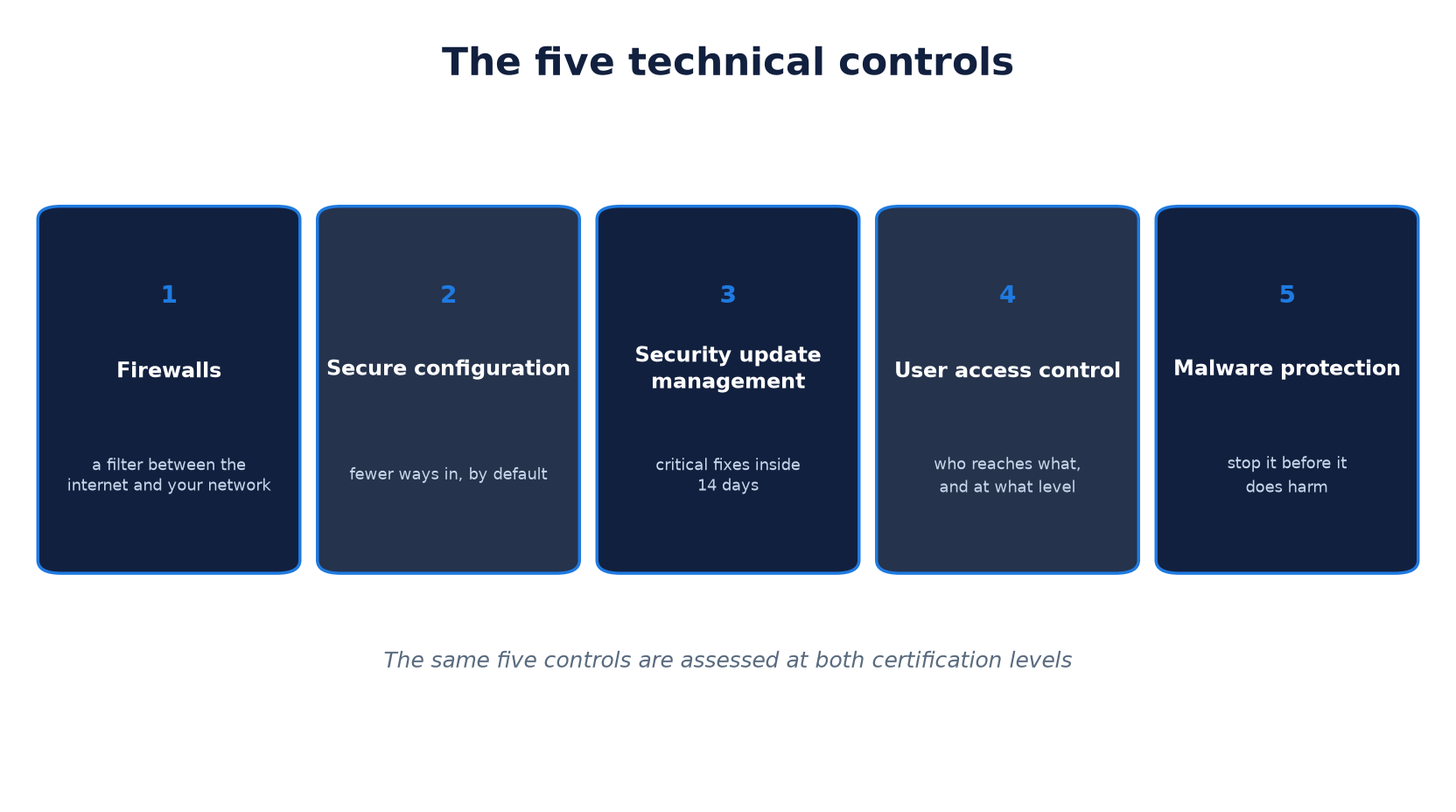
Diagram of the five Cyber Essentials technical controls
The five controls, in the scheme’s own terms. Each one is broader in scope than its name suggests, and the scope you declare is what they apply to.
Firewalls
A security filter between the internet and your network. In practice this covers boundary firewalls and the host firewalls on individual devices, which is the part organisations forget once staff are working from home on their own broadband.
Secure configuration
Setting up computers and devices so there are fewer ways in. Default accounts removed, unnecessary software and services disabled, and no default passwords left in place. This is the control that catches the appliance somebody racked in 2021 and never touched again.
Security update management
Keeping software patched so criminals cannot use known vulnerabilities as a way in. The requirement that bites is the timescale, because critical and high-severity updates are expected within 14 days. That single number has done more to focus patching programmes than any amount of risk assessment.
User access control
Controlling who can reach your data and services, and at what level. Accounts assigned to named individuals, administrative privileges granted only where needed, and separate accounts for administrative work rather than one account that does everything.
Malware protection
Identifying and stopping malicious software before it does harm, whether through anti-malware software, application allow-listing, or sandboxing.
None of this is exotic. That is the design. If an organisation cannot evidence these five, no amount of framework adoption above them is going to help.
Cyber Essentials versus Cyber Essentials Plus
This is the question that actually gets asked, and the difference is not the controls. Both certifications cover the same five. What changes is how hard somebody checks.
Cyber Essentials | Cyber Essentials Plus | |
|---|---|---|
Controls assessed | The same five | The same five |
Method | Self-assessment question set, independently reviewed | Independent technical testing of your systems |
Who looks at your estate | Nobody, unless questions prompt it | An assessor, hands on, against a sample of devices |
Priced on | Organisation size, from £320 plus VAT | Size and complexity of your network |
What it proves | You say you have the controls, and your answers are coherent | Somebody verified the controls actually operate |
Typical failure | Answering optimistically | Discovering an unpatched device you had forgotten |
The honest summary is that Cyber Essentials tests your understanding and your honesty, while Plus tests your estate. Both are useful, and they fail in different ways.
Which one your customers actually want
Read the contract clause rather than assuming. Public sector procurement in particular has been specific about which level it requires for years, and the difference in cost between the two is trivial next to the cost of discovering you hold the wrong one three days before a bid closes.
My own view is that Plus is worth the money for any organisation that holds customer data, regardless of whether a customer demands it, for one reason. Plus is the only version that would have found the thing you did not know about.
Scope is the decision that matters
Everything about your certification is determined by the scope you declare, and this is where organisations either succeed or quietly mislead themselves.
Scope can cover the whole organisation, or a defined subset such as a business unit or a specific network segment. Whole organisation scope is the strongest claim and the one most customers assume they are getting. A narrow scope is legitimate, it is disclosed on the certificate, and almost nobody reads that far.
Two practical consequences follow.
If you are certifying, be honest about what a narrow scope actually buys. A certificate covering a segment that excludes the estate holding customer data is technically valid and commercially misleading, and it will not survive a customer who reads it properly.
If you are relying on somebody else’s certificate, read the scope statement before you accept it as assurance. This series makes the same point about ISO 27001 certificates in the post on supplier assessment, and it applies with more force here, because the Cyber Essentials scope field is short, plain and almost never checked.
The whole organisation includes the awkward parts
Home workers, personally owned devices used for work, cloud services and mobile phones are all in scope when they touch organisational data. Organisations routinely scope those out mentally and not on paper. The assessor’s job is to notice.
Where it quietly fails larger estates
The scheme is built for a small organisation with a coherent estate. Applied to a large one, several strains appear.
The 14 day patching expectation is difficult across operational technology, clinical systems and anything with a vendor certification cycle. Those environments are not unusual, and the scheme’s answer is to scope them out, which produces a certificate that covers the easy part of the estate.
Unsupported software is a hard fail rather than a risk-managed position. That is defensible as a baseline and it collides with the reality of end-of-life systems that an earlier post in this series treats as a distinct risk class with a managed runway.
And the self-assessment question set rewards a particular kind of literalism. Large organisations with genuinely good security sometimes struggle to answer questions written for a fifty person company, while a smaller organisation with a simple estate breezes through.
None of that makes the scheme wrong. It makes it a floor rather than a ceiling, which is exactly what it claims to be.
The honest counterarguments
It is a tick box exercise
Frequently true of the basic level, and the criticism is fair when an organisation self-assesses generously and nobody checks. The response is that the controls themselves are not tick boxes, they are the five things that stop the majority of opportunistic attacks, and an organisation that genuinely holds them is meaningfully safer. If you doubt your own answers, that is an argument for Plus rather than against the scheme.
A certificate is a point in time
Also true. The estate on the day of assessment is not the estate six months later, and nothing in the scheme forces continuous compliance. Treat certification as an annual forcing function rather than a state, and keep the underlying controls under normal operational management the rest of the year.
It creates a false sense of security
This is the strongest criticism and it lands on how the certificate is used rather than on what it contains. An organisation that treats Cyber Essentials as evidence it is secure has misread a floor as a ceiling. An organisation that treats it as the baseline it must never fall below, with real risk management above it, has understood it correctly.
Common mistakes
Scoping to make certification easy rather than to describe the business. It works, it is disclosed, and it undermines the entire point.
Treating the question set as the specification. The question set is how the scheme samples your controls. The Requirements for IT Infrastructure document is what you actually have to meet, and reading it first makes the questions far easier to answer honestly.
Leaving it to IT alone. User access control and secure configuration reach into HR joiners and leavers, procurement and how staff actually work. An IT-only project finds this out late.
Certifying and then not telling anyone. If you hold it, put it in the tender library, tell the sales team what scope it covers, and diary the renewal. Certificates that lapse quietly cost real revenue.
Where to start
Download the question set and the Requirements for IT Infrastructure and read them together, in that order, before answering anything. Then decide your scope deliberately and write down why, because that decision is the one a customer will eventually test.
If you already hold the basic certification and have never done Plus, book it. The value is not the logo, it is the two days during which somebody competent looks at your estate and tells you what is actually there. In my experience that conversation surfaces at least one device nobody could account for, and finding it through an assessor is considerably cheaper than the alternative.
Written by P Larner. Drafting and copy-editing were assisted by AI tools, and header images are AI-generated. All technical claims are the author's.
Run your GRC programme in your own network.
RaptorGRC Community Edition is free: every module, offline licence activation, nothing phones home.
Register / Download Contact us