BLOG
Writing a Policy Set Nobody Ignores
Published 11 November 2026 · By P Larner
Compliance in Practice#policy management#Annex A#acceptable use#governance#ISO 27001#security policy#document control

Illustration for: Writing a Policy Set Nobody Ignores
Imagine asking a warehouse supervisor whether they have read the information security policy. They have signed for it twice. They describe it, accurately, as the thing you click through to get to the payslip portal. Then they explain, in detail and without prompting, exactly why they prop open the fire door to the yard on hot days, which is a genuine security control failure that no policy in the twenty document suite has ever addressed in language they would recognise.
That is the state of most policy sets. They are complete, approved, version controlled and inert. This post is about writing the other kind, which is shorter, harder and considerably more useful.
Why the twenty document suite fails
The standard policy suite is built by accumulation. A certification requires a topic, so a document appears. An incident happens, so a document appears. A consultant delivers a template pack, so fourteen documents appear. Nothing is ever retired, because retiring a policy feels like removing a control.
Three failures follow, and they compound.
Nobody can hold twenty documents in their head, so staff stop trying and rely on asking a colleague. The colleague is the real policy, and nobody has reviewed them.
Overlapping documents contradict each other. The remote working policy and the acceptable use policy disagree about personal devices, and both are current. When two approved documents conflict, staff reasonably conclude that neither is binding.
And the review cycle becomes the whole activity. Twenty documents on annual review means a document a fortnight passing through a committee that changes the date and nothing else. That is not governance, it is a treadmill that produces the appearance of currency.
Policy, standard, procedure, guideline
Most bad policy sets are bad because everything is a policy. Separating the layers is the single highest value change available, and it costs nothing but discipline.
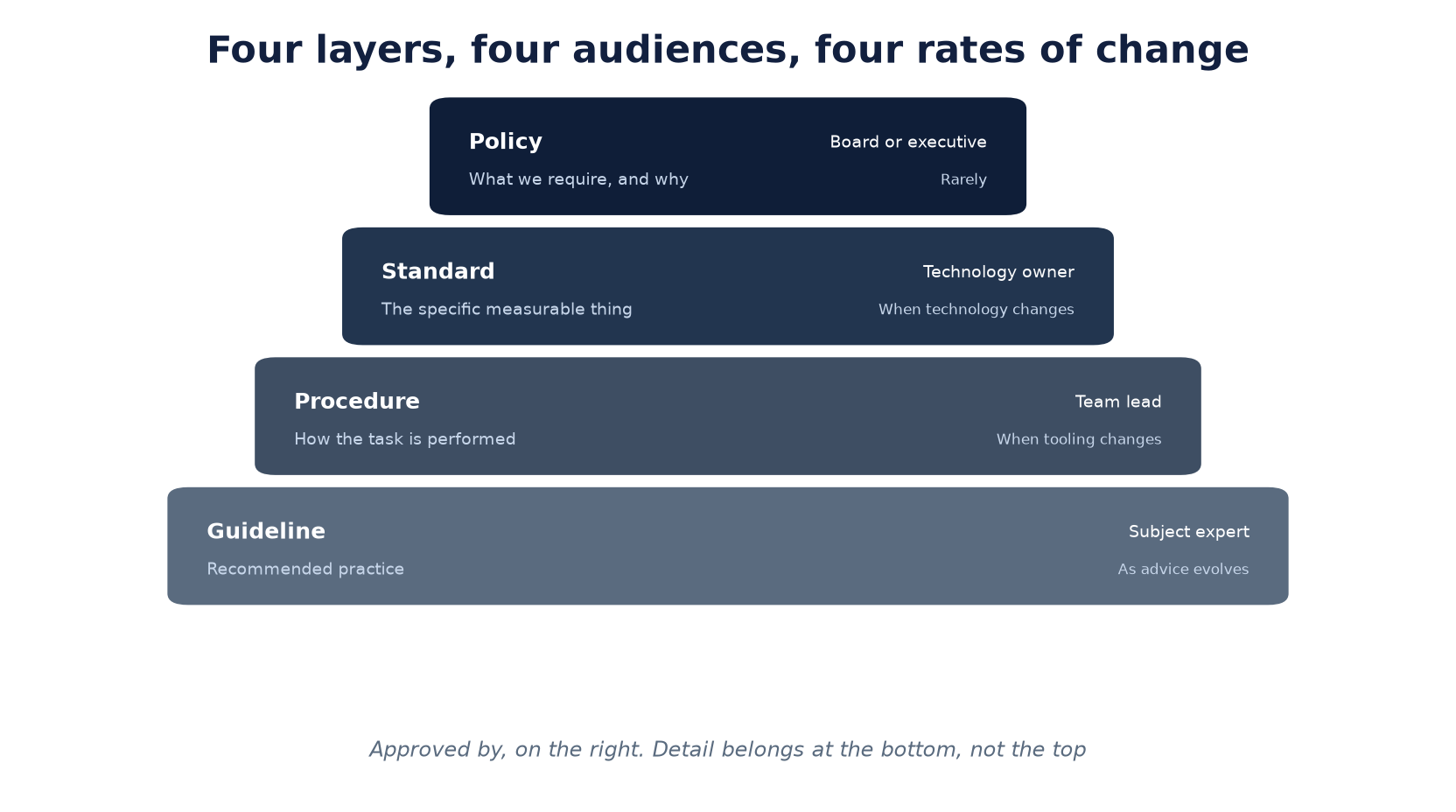
Diagram of the four document layers from policy down to guideline
Four layers, four audiences, four rates of change. Putting a screen lock timeout in the policy layer is why policies need approving every time a setting changes.
A policy states what the organisation requires and why, in terms that will still be true in three years. It is short, it is approved at a senior level, and it changes rarely.
A standard states the specific, measurable thing that must be true. Password length, encryption algorithm, patching window. It changes when technology changes, and it should be approved by whoever owns that technology rather than by the board.
A procedure states how a task is performed, step by step, for the person performing it. It changes whenever the tooling changes and it needs no committee at all.
A guideline offers recommended practice where genuine judgement is allowed. It is advice, and it should say so plainly rather than being written in the imperative and quietly ignored.
Getting this wrong has a specific and recognisable symptom. If your board is approving a document that specifies a timeout in minutes, your layers have collapsed, and the cost is that the timeout cannot be changed without a board paper.
Write for the person who has to comply
The most common defect in security policy is that it is written for the auditor. That is understandable, because the auditor is the reader who complains, and it produces documents that are unreadable by the people whose behaviour they are meant to govern.
Three habits fix most of it.
Use the second person and the active voice. “You must not connect personal storage devices to company laptops” is clear. “Personal storage devices shall not be connected to corporate endpoints” is the same rule dressed for a different reader.
Say why, once, briefly. Compliance improves measurably when a rule carries its reason, because people who understand a rule apply it to cases the rule did not anticipate. People who do not understand it apply it literally or not at all.
Name the exception route. Every rule will meet a case it should not cover. If there is no documented way to ask for an exception, people do not stop, they route around, and you lose the visibility that would have told you the rule was wrong.
Length is a control
A policy nobody finishes is a policy nobody follows. Two sides is a reasonable target for a policy, and if that feels impossible it is usually because standards and procedures have crept in. Move them down a layer and the policy shrinks on its own.
The set most organisations actually need
Certification schemes drive the topic list, and it is worth separating what a standard requires from what a business needs. ISO 27001 does not mandate twenty documents, and reading Annex A as a document list rather than a control list is how suites get bloated.
A workable core for a mid-sized organisation is around six to eight policies.
Policy | What it covers | What it must not contain |
|---|---|---|
Information security | The overarching commitment, roles, and how the rest hangs together | Technical settings |
Acceptable use | What staff may and may not do with systems and data | Anything only administrators do |
Access control | Who gets access, how it is approved, reviewed and removed | Specific group names |
Data protection | How personal data is handled and whose job that is | The record of processing itself |
Information classification and handling | The labels and what each one permits | The tooling configuration |
Supplier security | What is required of third parties and who assesses them | Individual contract terms |
Incident management | How to report, who decides, and the reporting duties | The incident runbooks |
Business continuity | The requirement to plan, test and own recovery objectives | The plan itself |
Everything else is a standard, a procedure or a section within one of those. Being able to say why a document exists at policy level is a discipline that prevents most of the bloat.
Approval, ownership and review
Every policy needs a named owner who is accountable for its content, not the person who drafted it and not the risk team who chase it. The owner is whoever would have to explain the rule to a regulator.
Review cycles should follow volatility rather than the calendar. An acceptable use policy might genuinely be stable for three years. A cloud security standard might need looking at twice a year. Setting everything to annual review creates the treadmill and guarantees that the documents needing attention are treated the same as those that do not.
Trigger-based review matters more than the cycle. A new product line, an acquisition, a significant incident, a change in law or a new regulator expectation should each prompt a look at the affected documents within weeks. An earlier post in this series makes the same argument about the Statement of Applicability, and the mechanism is identical.
Make compliance measurable
A rule that cannot be checked is a wish. For every policy statement, ask how you would know it was being followed, and be honest when the answer is that you would not.
The strongest sets pair each significant requirement with either a technical control that enforces it or a measure that detects breaches of it. Where neither exists, the statement is a cultural expectation, which is legitimate as long as it is labelled as one rather than presented as a rule with teeth it does not have.
This also gives you the honest answer to the audit question about how you monitor compliance, which is otherwise answered with the word “training”.
The honest counterarguments
Policies exist for the auditor, and that is fine
There is something to this. Certification requires documented policies, contracts require them, and a well drafted set genuinely does reduce argument about what was expected. The rebuttal is that the two goals are not in tension. A short, clear, owned policy satisfies an auditor at least as well as a long one, and a document that also changes behaviour is strictly better than one that does not.
Nobody reads policies regardless of how they are written
Largely true at the moment of induction, and it does not follow that writing is wasted. People read policies at exactly two moments, which are when they are about to do something unusual and when something has gone wrong. Both are moments where clarity matters enormously, and both are badly served by a forty page document with no index.
Fewer documents means less coverage
Only if coverage means document count. Moving detail from policy into standards and procedures does not remove it, it relocates it to where it can be maintained by the people who understand it. The suite gets shorter and the control set gets stronger, which is counterintuitive enough that it is worth stating explicitly to whoever owns the certification.
Common mistakes
Templates adopted wholesale. A downloaded pack describes somebody else’s organisation, and the mismatch shows up in the first audit interview when nobody recognises the process described.
Policies that reference systems by name. The moment you migrate, the document is wrong, and nobody updates it.
Signature capture treated as assurance. A recorded acknowledgement proves the document was presented. It says nothing about comprehension, and presenting it as evidence of understanding is a claim that will not survive contact with a real incident.
No archive. When a policy changes, the previous version and its dates matter, because an investigation into something that happened last year needs the rule as it stood last year.
Writing rules the organisation cannot meet. A policy demanding fourteen day patching in an environment with annual outage windows is a documented, approved, permanent breach. Write what the environment can achieve, then improve the environment.
Where to start
Print your current policy set, put it on a table, and count the pages. Then take one recent security decision somebody in the business had to make, and try to find the answer in the pile. Time yourself.
That exercise usually settles the argument about whether the set needs work. From there, the order that works is to agree the four layers, decide which existing documents are actually standards or procedures, and move them down. Most organisations find their policy count halves before a single word is rewritten, and the half that remains is suddenly short enough to be worth writing properly.
Written by P Larner. Drafting and copy-editing were assisted by AI tools, and header images are AI-generated. All technical claims are the author's.
Run your GRC programme in your own network.
RaptorGRC Community Edition is free: every module, offline licence activation, nothing phones home.
Register / Download Contact us