BLOG
Cryptographic Bills of Materials: The Inventory Behind the Quantum Deadline
Published 25 October 2026 · By P Larner
Security in Practice#Cryptographic bill of materials#TLS 1.3#SBOM#Supply chain security#NCSC#PQC migration#CycloneDX#Post quantum cryptography#CBOM#Cryptographic inventory#Risk management

Illustration for: Cryptographic Bills of Materials, The Inventory Behind the Quantum Deadline
Ask an organisation where its cryptography is and you will usually get a certificate list. It comes out of a certificate management tool or a spreadsheet the infrastructure team keeps, and it names a few hundred certificates with their expiry dates. It says nothing about the algorithm a payment service negotiates, the key a firmware image was signed with, or the library buried in a supplier’s appliance that still insists on RSA.
That gap used to be a hygiene problem. The quantum threat turns it into a deadline. The National Cyber Security Centre expects organisations to have carried out a full discovery exercise by 2028, and discovery is exactly the question the certificate list cannot answer. A cryptographic bill of materials, usually shortened to CBOM, is the most promising structured answer available. It is also easy to build badly, and it is not quite what the NCSC asked for.
Why the quantum threat is an inventory problem
A cryptographically relevant quantum computer would break the public key algorithms that protect key exchange and digital signatures today, which means RSA, Diffie-Hellman and elliptic curve cryptography. Nobody can date its arrival, and the NCSC says plainly in its post quantum whitepaper that it is hard to predict. Two things make the timing matter now anyway.
Data captured today can be read later
The NCSC describes the risk as an attacker “collecting and storing data today and decrypting it at some point in the future”. Anything that must stay confidential for longer than it will take a capable machine to arrive is already exposed when it crosses a network protected only by classical key exchange.
Migration takes longer than people expect
Replacing cryptography is not a patch. It touches protocols, libraries, hardware roots of trust, certificate hierarchies and the suppliers who build all of them. I covered the proportionate response in an earlier post on post quantum migration, and the short version is that every useful decision depends on knowing where the cryptography is. You cannot prioritise, budget or ask a supplier the right question about something you have not found.
What the NCSC actually asks for
The NCSC published its timelines for migration to post quantum cryptography on 20 March 2025. The guidance sets three milestones.
By 2028, organisations should define their migration goals, “carry out a full discovery exercise” and build an initial migration plan. By 2031, they should carry out their early, highest priority migration activities and refine the plan into a thorough roadmap. By 2035, they should complete migration of all systems, services and products.
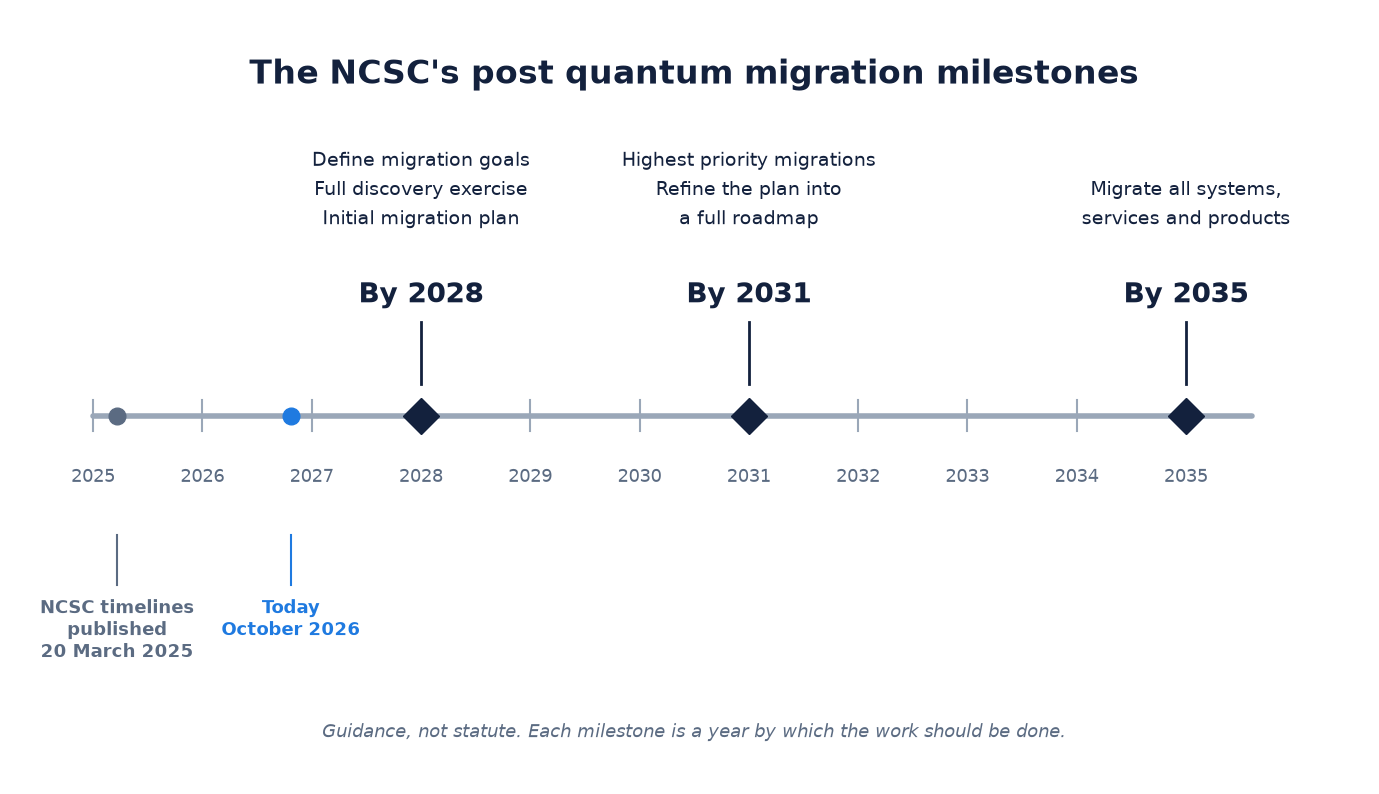
Timeline of the NCSC post quantum migration milestones, with discovery and an initial plan by 2028, highest priority migrations by 2031 and full migration by 2035
The 2028 milestone is the one that needs an inventory. Everything after it depends on what discovery finds.
The milestones are guidance rather than law. The NCSC aims them mainly at large organisations, operators of critical national infrastructure and companies with bespoke IT, and it expects smaller organisations on commodity IT to receive most of the migration through their suppliers. Custom software follows the same timetable whatever the size of the organisation that owns it.
Discovery, in the NCSC’s own terms
The discovery section of the timelines guidance is worth reading closely, because it shapes what a useful inventory looks like. It says the exercise “is not intended to be a formal asset register”. The point is to understand the nature of each system well enough to plan its migration. The guidance asks organisations to quantify the scale of each system and to capture version information and patch levels where they can.
The scope is wider than most certificate tools reach. The guidance names networking and communications hardware, internet of things and industrial control system devices with a communications function, and devices and sensors installed in the field. It asks for a record of the data you hold, including its expected lifetime and its value to an adversary. And where managed service providers deliver most of your IT, it expects you to confirm they are doing the same assessment for the services they run.
The NCSC’s workshop report of July 2026 is blunter about timing. “The first steps (discovery, prioritisation and roadmap development) should be happening now, and will define success later.”
Notice what the guidance does not say. It does not mention a cryptographic bill of materials, and it does not prescribe any inventory format.
What a cryptographic bill of materials is
A CBOM is a machine readable inventory of the cryptographic assets in a system and how they relate to the software and hardware that use them. The most developed format is part of CycloneDX, the OWASP bill of materials standard. CycloneDX 1.6, released in April 2024, added cryptographic assets as a component type in their own right, and the specification was published by Ecma International as ECMA-424 the same year.
In the CycloneDX 1.6 schema a cryptographic asset is one of four types.
Asset type | What it records | Example |
|---|---|---|
Algorithm | The primitive, parameter set, mode and security level | ML-KEM-768 key encapsulation, AES-256 in GCM mode |
Certificate | Subject, issuer, validity dates and the algorithms used to sign it | A TLS server certificate signed with ECDSA P-256 |
Protocol | The protocol type, version and cipher suites in use | TLS 1.2 on a payment gateway |
Related crypto material | Keys, secrets, tokens, passwords and similar material | An RSA-2048 private key held in a hardware security module |
Two fields matter most for quantum planning. Every algorithm can carry an object identifier, which removes the ambiguity of free text names, and a NIST quantum security level from 0 to 6, where 0 means the algorithm meets none of NIST’s post quantum security categories. Filter an inventory on that field and the quantum vulnerable public key algorithms fall out of it, which is the first cut of a migration backlog.
The relationships matter as much as the assets. A CBOM records that a particular service uses a particular library, which negotiates a particular protocol, using a particular algorithm, authenticated by a particular certificate. That chain is what turns a list of algorithms into an answer to the question “which services break if RSA does”.
How it differs from a software bill of materials
The two are related, and a CBOM can live inside the same CycloneDX document as a software bill of materials. They answer different questions.
Software bill of materials | Cryptographic bill of materials | |
|---|---|---|
The question it answers | Are we running a vulnerable component? | Where do we depend on algorithms that will need replacing? |
What triggers it | A new vulnerability advisory | A change in the threat to an algorithm, or a new standard |
What it lists | Components, versions, suppliers, licences | Algorithms, certificates, protocols, keys and their relationships |
Where the evidence comes from | Mostly the build pipeline | The build pipeline, running systems, network traffic and suppliers |
The last row is the important one. Software composition analysis can tell you a library is present. It cannot always tell you which algorithm that library actually negotiates at runtime, which depends on configuration, on the peer at the other end and on what each side will fall back to. A CBOM built only from the build pipeline will be confidently incomplete. I made the same argument about software bills of materials in an earlier post, and it applies with more force here.
Where a CBOM fits the NCSC’s discovery, and where it does not
A well built CBOM covers the technical half of the NCSC’s discovery exercise better than anything else available. It names the algorithms, protocols, certificates and keys, ties them to systems, and does so in a form that tools can query and compare over time.
It does not cover the other half. The NCSC wants discovery to support prioritisation, and its prioritisation runs on business facts. Which services process your most valuable or long lived data. Which systems would cause the greatest impact if breached. Which suppliers will migrate for you and when. None of those live in a CBOM.
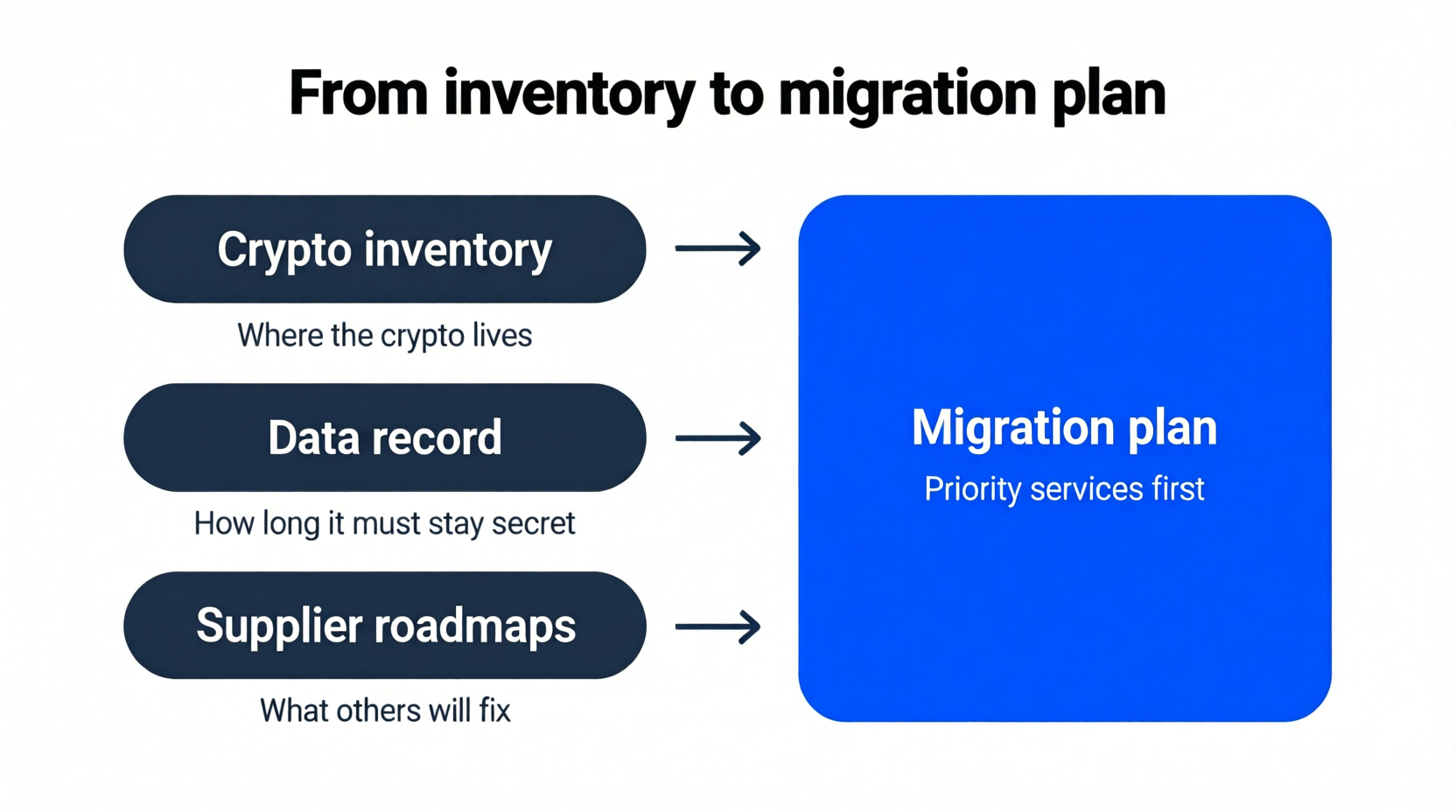
Diagram showing a crypto inventory, a data record and supplier roadmaps feeding a migration plan that puts priority services first
The CBOM is the first of three inputs. Without the data record and the supplier position it tells you what is vulnerable but not what matters.
My view is that this is why the NCSC was careful to say discovery is not a formal asset register. An organisation that treats the CBOM as the deliverable will produce a large, accurate file and still be unable to say which three services to migrate first. The deliverable is the initial migration plan, and the CBOM is the evidence underneath it.
Building one without boiling the ocean
What follows is my recommended approach rather than anything the NCSC prescribes.
Start from priority services, not from the network
Pick the services that handle data with a long confidentiality lifetime, or whose compromise would hurt most, and inventory those first. A complete CBOM of the services that matter is worth more in 2028 than a partial one of everything.
Combine discovery methods
No single technique sees everything, so use several and record which one found each asset.
- Scan network endpoints to see which protocols, versions and key exchange groups services actually negotiate.
- Export certificate stores, key management services and hardware security module inventories.
- Scan source code and binaries for cryptographic library calls and hard coded algorithms.
- Read configuration for TLS, SSH, IPsec and virtual private network settings.
- Collect supplier statements for anything you cannot inspect.
Record what you could not see
Embedded devices, operational technology and field equipment are named in the NCSC’s scope and are often the hardest to scan safely. An honest CBOM marks these as unknown, with the reason, rather than leaving them out. An inventory that silently omits the control system estate will be read as saying it has no cryptography.
Ask suppliers for theirs
Most of your cryptography is somebody else’s. The NCSC workshop report noted that suppliers publishing their plans and progress would let their customers manage their own planning. Ask for a CBOM, or at least a statement of algorithms and a migration roadmap, in procurement and at contract renewal. Few suppliers can provide one today, in my experience, and asking is how that changes.
Keep it live
A CBOM produced once for a 2028 report will be wrong by 2029. Generate the software side in the build pipeline, rescan the runtime side on a schedule, and store the results somewhere you can query across every system.
What to flag in it
Once the inventory exists, a handful of checks turn it into a prioritised list. These map to current NCSC guidance.
Finding | Why it matters | NCSC source |
|---|---|---|
TLS 1.2 or earlier on a service | TLS 1.3 is the only version that supports post quantum key exchange, and earlier versions will not be upgraded | |
Classical only key exchange on paths carrying long lived data | This is the harvest now, decrypt later exposure | Post quantum whitepaper |
Long lived signing keys and trust anchors | Certificate hierarchies and firmware roots of trust take years to replace | Migration timelines, which ask the initial plan to cover long lived hardware roots of trust |
Post quantum parameter sets that differ from the recommendation | The NCSC recommends ML-KEM-768 and ML-DSA-65 for most uses | Post quantum whitepaper |
Stateful hash based signatures outside firmware signing | The NCSC limits LMS and XMSS to cases where signing state can be managed in a trusted manner | Post quantum whitepaper |
The NCSC’s October 2026 TLS update goes further on the first row. It recommends both hybrid and pure post quantum key exchange options and says organisations “should be aiming to make this move now”. A CBOM that shows which services still run TLS 1.2 is a ready made work list.
Where the United States is heading
The UK has no statutory requirement here, but the direction elsewhere is worth knowing, because suppliers will build to it. Executive Order 14412, signed on 22 June 2026, requires US federal agencies to move their high value assets and high impact systems to post quantum key establishment by 31 December 2030 and to post quantum signatures by 31 December 2031. It also directs CISA, working with NIST, to publish the minimum elements of a cryptographic bill of materials within 270 days of the order, which falls in March 2027.
If that guidance lands as planned, the CBOM stops being an emerging format and becomes something large suppliers produce as standard. UK buyers will benefit whether or not the NCSC adopts it.
The honest counterarguments
This is SBOM ceremony all over again
A fair worry. Plenty of software bills of materials are produced to satisfy a contract and never read. The same will happen to CBOMs that are generated for a report rather than built to answer a question. The defence is to start with the question, which services to migrate first, and build only as much inventory as that question needs.
Scanners only find what they can see
True, and it is the strongest case against trusting any automated inventory. Network scans miss internal paths, code scans miss runtime configuration, and neither reaches sealed appliances. That is why the method column and the unknown marker matter. An inventory that states its own blind spots is more useful than one that hides them.
The NCSC did not ask for a CBOM
Correct. The guidance asks for discovery and a plan, says explicitly that it is not asking for a formal asset register, and names no format. An organisation could meet the 2028 milestone with well structured service records and no CBOM at all. My view is that a standard, machine readable format is still the better choice, because the discovery will need repeating for a decade and a format that tools and suppliers share is cheaper to repeat. It is a recommendation, not a requirement.
Common mistakes
Treating the certificate list as the inventory, which misses protocols, libraries, keys and everything without a certificate.
Building from the build pipeline only, which records what could be used rather than what is negotiated.
Leaving out operational technology because it is hard to scan, when the NCSC names it in scope.
Producing the CBOM without the data record, which shows what is vulnerable and nothing about what matters.
Running discovery once, as a 2028 project, when migration will run to 2035.
Where to start
Go back to the certificate list from the opening. Pick one service that carries data with a long confidentiality lifetime, and build its cryptographic inventory properly. Record the protocols it negotiates, the libraries that implement them, the keys and certificates it relies on, the suppliers involved and anything you could not see.
That single record will show you what your inventory needs to capture, which discovery methods work in your estate and where the gaps are. It also gives the 2028 milestone a first piece of evidence, which is more than most organisations have today. Then do the next service, and write down why it was next.
Written by P Larner. Drafting and copy-editing were assisted by AI tools, and header images are AI-generated. All technical claims are the author's.
Run your GRC programme in your own network.
RaptorGRC Community Edition is free: every module, offline licence activation, nothing phones home.
Register / Download Contact us