BLOG
Security Awareness After the Click Rate
Published 20 November 2026 · By P Larner
Security in Practice#security culture#incident reporting#phishing simulation#security awareness#business email compromise#phishing#board reporting

Illustration for: Security Awareness After the Click Rate
The board slide said the phishing click rate had fallen from eighteen per cent to four. Everyone was pleased. What the slide did not say was that the simulations had got easier, that the same four per cent were clicking every time, and that in the one real incident that year the person who spotted it did not report it for six hours because they were not sure who to tell and were worried about looking stupid.
Click rate is the metric the industry settled on because it is easy to produce, not because it measures anything that protects an organisation. This post is about what to measure instead, and what awareness training should actually be trying to change.
What the click rate really tells you
A simulated phishing click rate measures how many people clicked a specific email, of a specific difficulty, on a specific day, in a specific context. It is a measurement of the simulation at least as much as of the workforce.
Three things make it unreliable as a trend.
Difficulty is not controlled. Unless you are deliberately holding the sophistication of the lure constant, a falling click rate may simply mean you are sending easier tests. Most programmes drift easier over time, because a rising number is uncomfortable to report.
The population is not stable. New joiners, seasonal staff and a reorganised department all move the number without anything having changed about behaviour.
And the metric has an obvious gaming route. Staff learn to recognise the simulation platform rather than the phishing, whether by the sending domain, the timing, or the fact that the fourth Tuesday of every month brings a suspicious email. You have trained pattern recognition of your own tooling.
None of that means simulations are worthless. It means the click rate is the wrong output.
Measure reporting, not clicking
The single most valuable behaviour in a real incident is not that nobody clicks. Somebody will always click. The behaviour that changes outcomes is that the click is reported quickly, and that other people who received the same message report it too.
That reframing changes what you measure.
Instead of | Measure | Because |
|---|---|---|
Click rate | Report rate | Reporting is the behaviour that shortens an incident |
Click rate trend | Median time to first report | Speed is what limits damage |
Who clicked | Reports per simulated campaign, including from non-clickers | Shows the workforce is actively watching |
Training completion | Repeat clicker population and whether it shrinks | Identifies where targeted help is needed |
Nothing | Real reports per month, and how many were genuine | Tells you the channel is trusted and used |
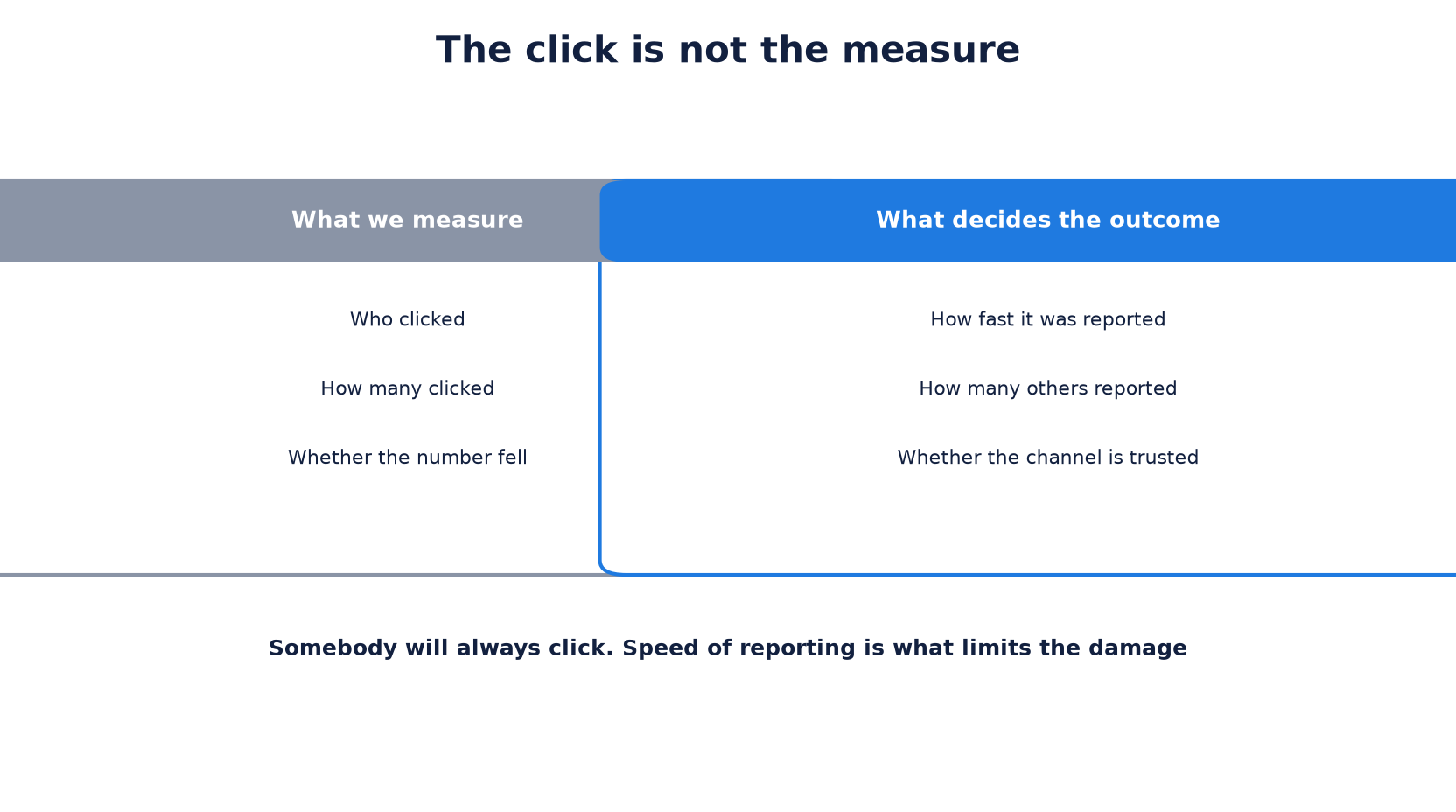
Diagram contrasting a click rate measure with a reporting speed measure
The click will happen. What determines the outcome is how fast somebody says so, and whether the people who did not click also spoke up.
The last row deserves attention. A reporting channel that receives nothing is not evidence of a clean estate, it is evidence that nobody uses it. Real reports, including false alarms, are a health indicator, and an organisation whose staff report harmless marketing emails is in a far better position than one where the channel is silent.
Make reporting genuinely frictionless
If you take one thing from this post, take this. The reporting mechanism must be faster than deciding whether to bother.
That means a button in the mail client rather than an address people have to remember. It means one click, no form, no explanation required. It means an immediate acknowledgement so the person knows it arrived. And it means feedback when the report was useful, because nothing sustains a behaviour like being told it mattered.
It also means no consequences for being wrong. The moment somebody is made to feel foolish for reporting a legitimate newsletter, you have taught the whole floor to stay quiet. The correct response to a false alarm is thanks.
The six hour problem
The delay in the opening story is the real failure, and it is almost always cultural rather than technical. People delay because they are unsure who to tell, because they think they might be mistaken, or because they fear the reaction to having clicked.
The fix is to say, repeatedly and from senior people, that reporting a click is welcome and that nobody has ever been disciplined for it. Then make it true. One story of somebody being blamed will undo a year of messaging.
Training that changes behaviour
The annual computer based training module has a poor reputation and mostly deserves it. It is built for evidence of completion rather than for changing what people do.
Three principles produce better results.
Make it specific to the role. Finance staff face invoice fraud and payment redirection. Developers face dependency compromise and credential leakage. Executives face impersonation and targeted approaches. A single module covering all of it serves none of them well.
Make it short and frequent rather than long and annual. Attention decays quickly, and a five minute intervention four times a year beats forty minutes once.
Teach the request, not the appearance. The old advice about spelling mistakes and odd greetings is now actively misleading, because generative tools have removed those signals entirely. An earlier post in this series makes the same point about frontier AI raising the quality of the prose. What has not changed is the shape of the request, which is urgency, secrecy, a change of payment details, or pressure to bypass a normal process. Teach people to react to the ask.
Verification as a taught behaviour
The most valuable single habit to instil is out of band verification. Somebody asks you to change bank details, move money, or grant access, and you confirm through a channel the requester did not choose, using a number you already had. That habit defeats phishing, business email compromise, voice cloning and most social engineering in one move, and it is far easier to teach than pattern recognition.
Simulations, run properly
Simulations still have a place. They just need different rules.
Vary difficulty deliberately and record it, so the trend means something. Include the occasional genuinely hard lure so people know sophisticated attempts exist. Never use cruel pretexts such as bonus announcements or redundancy notices, because the damage to trust outlasts any learning. Debrief immediately at the point of the click with a short explanation rather than a punishment. And measure the campaign, not the individual, except where a repeat pattern indicates somebody needs help rather than exposure.
Above all, do not tie results to performance management. The moment simulation results reach an appraisal, you have converted an educational tool into a compliance threat and people will optimise accordingly.
The honest counterarguments
Awareness training does not work
There is genuine evidence behind this, and the strongest version of the argument is that humans are a poor last line of defence and effort belongs in technical controls that remove the decision entirely. Much of that is right. Where it goes wrong is treating it as a reason to do nothing, because no technical control catches everything, and the residual cases are exactly where a fast report changes the outcome.
Simulations are manipulative
They involve deceiving your own staff, which deserves more discomfort than it usually gets. The defence is that the deception is disclosed, the intent is protective, and the alternative deception is being run by criminals. The line I would hold is that a simulation must never exploit personal circumstances, and must never punish.
The metrics are still soft
Report rate and time to report are better than click rate and are still proxies. The genuinely hard outcome measure, which is incidents avoided, is unobservable. That is a real limitation and the honest position is that these measures track a behaviour known to reduce harm, rather than proving harm reduced.
Common mistakes
Reporting click rate to the board as a security posture measure. It invites the wrong question and rewards easier simulations.
Punishing clickers. It suppresses reporting, which is the behaviour worth more than the clicking is worth avoiding.
One module for everybody, annually, tracked by completion percentage. This is a compliance artefact, and it is fine to have one as long as nobody confuses it with a control.
No feedback loop. People who report and hear nothing stop reporting.
Ignoring the people who never click and never report. A workforce that is neither falling for lures nor spotting them is not engaged, it is passive, and passivity is the state you are trying to leave.
Where to start
Find out how long it takes a report to reach somebody who can act, from the moment a member of staff decides to raise it. Measure it honestly, including out of hours. If the answer is more than a few minutes, fix the channel before you buy any more training.
Then change the headline measure in your next board pack from click rate to report rate and median time to report, and explain why in two sentences. That single substitution reorients the whole programme, because what gets reported to the board is what the organisation optimises for, and optimising for people speaking up quickly is a considerably better goal than optimising for a number that mostly measures how hard you made the test.
Written by P Larner. Drafting and copy-editing were assisted by AI tools, and header images are AI-generated. All technical claims are the author's.
Run your GRC programme in your own network.
RaptorGRC Community Edition is free: every module, offline licence activation, nothing phones home.
Register / Download Contact us