BLOG
Vulnerability Disclosure and the Coordinated Route
Published 27 November 2026 · By P Larner
Security in Practice#security.txt#safe harbour#incident response#bug bounty#vulnerability disclosure#Computer Misuse Act#security research

Illustration for: Vulnerability Disclosure and the Coordinated Route
Somebody has found a flaw in your product. They are trying to tell you. They have emailed the address on your website, which goes to a shared mailbox monitored by marketing, and they have had no reply for nine days. What happens next is entirely determined by decisions you made, or failed to make, long before they found anything.
The organisations that handle this well spend almost nothing on it. The ones that handle it badly usually discover the flaw at the same time as everybody else, having converted a cooperative researcher into an annoyed one. This post is about the cheap version of getting it right.
What coordinated disclosure actually means
Coordinated vulnerability disclosure is an agreement, usually informal, that a finder will give the affected organisation a reasonable opportunity to fix a flaw before details become public. Both halves matter. The finder does not publish immediately. The organisation actually fixes it, and does so in a defined time.
It sits between two worse alternatives. Full disclosure publishes immediately and puts users at risk while a fix is written. Non disclosure, where the finder stays silent indefinitely, leaves the flaw in place for whoever finds it next, who may be less friendly.
The word coordinated is doing work. This is a negotiation between parties with different interests, conducted mostly by strangers, usually by email, sometimes across languages and time zones. Everything that makes negotiations go badly applies.
Why you want the email
The instinct in some organisations is that a disclosure report is a problem. It is the opposite. A researcher contacting you privately has chosen the option that costs them the most effort and gains them the least, and they have done so because they expect you to behave reasonably.
The alternatives to that email are all worse. Somebody sells the finding. Somebody publishes it with a proof of concept and no warning. Somebody uses it. Or nobody tells you and it sits there until an incident.
Treating the report as an attack, or responding with legal threats, is the one behaviour guaranteed to produce the worst outcome, because it removes any reason for the next finder to contact you and it tends to become public.
The policy costs almost nothing
A vulnerability disclosure policy is a short public page that tells a finder how to reach you and what to expect. It is the single highest return security document available, and most organisations do not have one.
It needs six things.
A dedicated contact route that is not a general enquiries mailbox, and that somebody technical actually monitors.
A statement of scope, saying which systems and products you want reports about and, just as importantly, which are out of bounds.
What you commit to, which at minimum is acknowledging receipt within a stated period and keeping the finder informed.
What you ask of the finder, which is normally that they do not access or modify other people’s data, do not degrade the service, and give you a reasonable window before publishing.
A safe harbour statement, saying that you will not pursue legal action against people acting in good faith within the policy.
And a note on recognition, whether that is credit in an advisory, a public thank you, or nothing, stated honestly.
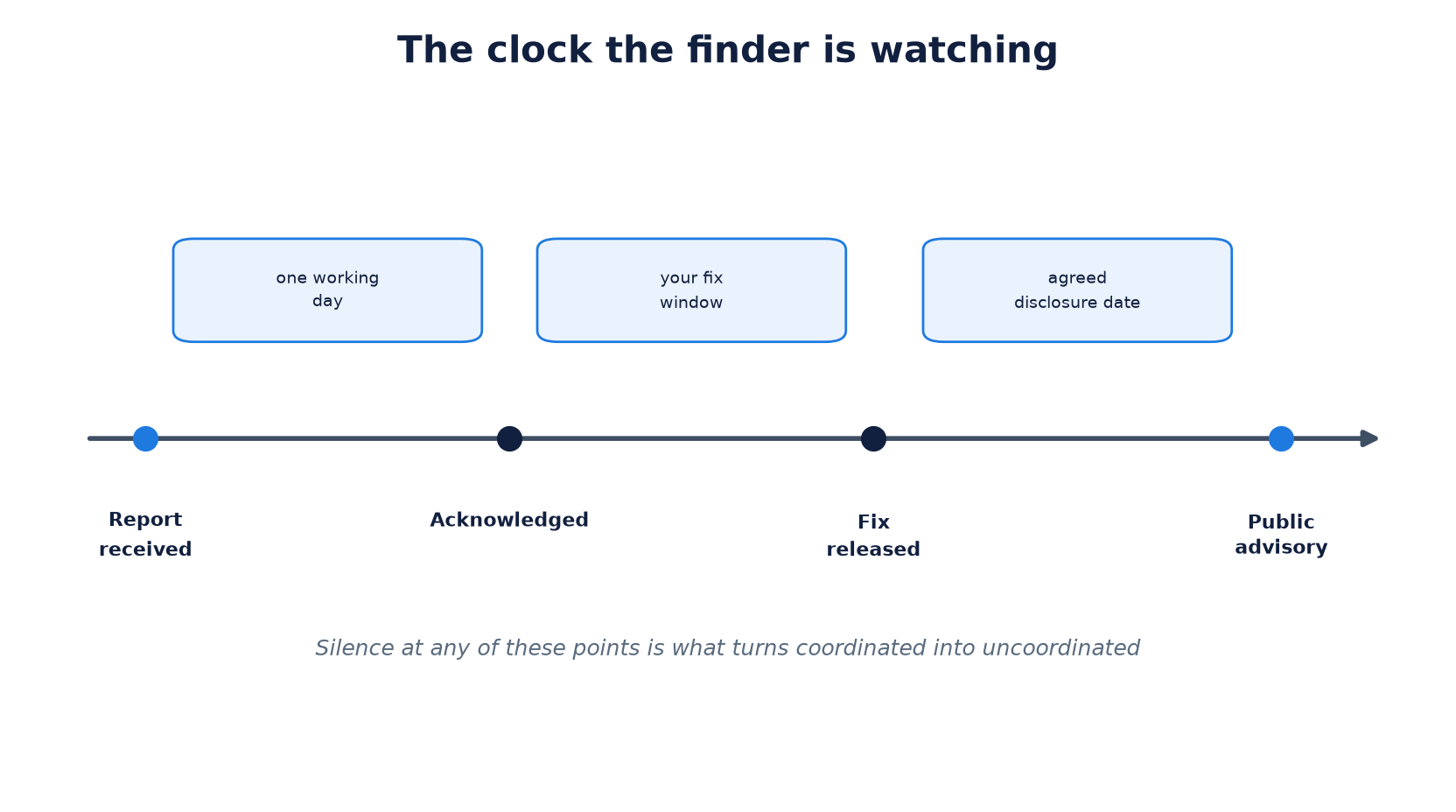
Diagram of the disclosure timeline from report to public advisory
The clock a finder is watching, and the four moments where organisations most often go quiet. Silence is what turns a coordinated disclosure into an uncoordinated one.
Publish it where a finder will look
Two conventions have emerged and both are cheap. A page at a predictable path on your website, and a security.txt file served at a well known location on your domain, which is the machine readable equivalent. Researchers check both before resorting to guessing at mailboxes.
Running the process when a report arrives
The failure mode is almost never the fix. It is the silence.
Acknowledge fast, ideally within one working day, even if the acknowledgement says nothing more than that you have it and a named person is looking. A finder who hears nothing assumes the report vanished, and their next step is often a public post asking whether anyone knows how to contact you.
Triage properly, and separate severity from exploitability in the way this series argues for scanner findings. A researcher’s severity assessment is their opinion of the technical flaw and may not reflect your environment, in either direction.
Keep the finder informed at intervals you have stated. Most researchers are entirely reasonable about a fix taking time and entirely unreasonable about being ignored for six weeks.
Agree the disclosure timing explicitly rather than assuming. Ninety days has become a widely used default, and it is a convention rather than a rule. If you need longer for a good reason, ask, explain why, and expect to justify it. If you need less, say so.
Then credit them, if they want it. This costs nothing and buys a great deal.
Bug bounties are a different thing
A bug bounty is a paid programme, usually run through a platform, that invites a large population to look. A disclosure policy is a route for people who were going to look anyway.
Do not start with a bounty. The volume of a public bounty programme will overwhelm an organisation that has not yet built triage capacity, and most of the early volume is low quality. Organisations that launch a bounty before they can handle a disclosure policy end up with a backlog, frustrated participants and a poor reputation among exactly the community they were trying to attract.
The sensible sequence is a disclosure policy first, then a private invitation-only programme once triage is reliable, then a public bounty only if the volume and the budget both justify it.
Where it touches the law
Two things are worth knowing without pretending this is legal advice.
The safe harbour statement in your policy is not a change to the law. In the UK, the Computer Misuse Act does not contain a research exemption, and there has been sustained argument from the security community that it should. What your statement does is tell a finder that you will not initiate action against good faith research, which removes the main deterrent to them contacting you at all.
And if the vulnerability has been exploited, you are no longer only in disclosure territory. A report that arrives with evidence of exploitation is an incident, with the reporting clocks and duties covered elsewhere in this series, and it should be routed accordingly rather than handled as correspondence.
The honest counterarguments
It invites attention you would rather not have
The concern is that publishing a policy tells people to come and look. In practice they are already looking, and the policy determines only whether the findings reach you or reach the internet. What the policy does change is volume, since you will receive more low quality reports, and that cost is real and manageable.
Most reports are noise
A significant share of unsolicited reports are automated scanner output, missing security headers presented as critical, or outright nonsense, sometimes accompanied by a demand for payment. That is genuinely tiresome. The answer is a scope statement that rules the common noise out explicitly, and a short template response, rather than abandoning the channel that also carries the serious reports.
Ninety days is arbitrary and sometimes impossible
It is arbitrary, and for embedded systems, operational technology or anything with a certification cycle it can be genuinely unachievable. The response is to negotiate early and honestly rather than to let the deadline arrive in silence. Researchers extend deadlines regularly for organisations that are visibly working and communicating, and almost never for organisations that have gone quiet.
Common mistakes
No route at all, so reports arrive at sales, at a personal LinkedIn account, or nowhere.
Legal responding first. A letter from a solicitor as the opening move is the single most reliable way to make a private report public.
Fixing quietly with no advisory. Customers running your product need to know there is a fix and why it matters, and silent patching leaves them unable to prioritise it.
Treating the finder as the adversary. They are the person who told you.
No internal owner, so the report bounces between product, security and support while the clock runs.
Where to start
Write the page this week. It is one side, it needs a mailbox that a technical person watches, and it should include a safe harbour statement and a scope. Add a security.txt file while you are there, which takes minutes.
Then run one internal rehearsal. Send a realistic report to the new address from an outside account and see what happens. Time the acknowledgement. If nothing happens for three days, you have learned the same thing the researcher in the opening paragraph learned, at considerably lower cost.
Written by P Larner. Drafting and copy-editing were assisted by AI tools, and header images are AI-generated. All technical claims are the author's.
Run your GRC programme in your own network.
RaptorGRC Community Edition is free: every module, offline licence activation, nothing phones home.
Register / Download Contact us