BLOG
Penetration Testing: Scoping, Reading and Acting on the Report
Published 25 November 2026 · By P Larner
Security in Practice#remediation#NCSC#penetration testing#CREST#vulnerability management#security testing#scoping

Illustration for: Penetration Testing, Scoping, Reading and Acting on the Report
Most of the value of a penetration test is decided before the testers start and lost after they finish. The testing itself is the part organisations think about, and it is the part they have least influence over. The scope you wrote three weeks earlier determines what can be found, and what you do in the eight weeks afterwards determines whether finding it mattered.
It is common for an organisation to buy the same test annually for five years, receive a similar report each time, and remediate the criticals while the medium findings accumulate quietly into the architecture. This post is about the parts either side of the test.
What a penetration test is, and is not
A penetration test is a time boxed, human led attempt to find and exploit weaknesses in a defined target, producing evidence of what an attacker could achieve. That definition contains three constraints worth stating plainly.
Time boxed means a tester with a fortnight will not find everything a motivated adversary with six months would. Absence of a finding is not evidence of absence.
Defined target means the test can only cover what you scoped. Findings outside scope are not reported, and in many cases not even looked for.
Human led distinguishes it from a vulnerability scan. A scan enumerates known weaknesses. A test chains them, exercises business logic, and answers what an attacker could actually do, which no scanner does well. Paying test prices for what is effectively a scan is one of the more common ways to waste the budget.
What it does not tell you
A clean report does not mean you are secure. It means that these testers, in this window, against this scope, using this level of access, did not achieve the objectives set. Every one of those qualifiers matters, and the report will state them if you read the methodology section, which almost nobody does.
Scoping decides everything
Scoping is the highest leverage activity in the whole exercise and it is routinely delegated to whoever is free.
Four decisions do most of the work.
What is in scope, and what is deliberately not
Be explicit about both. The exclusions matter as much as the inclusions, because they define the shape of the assurance you are buying. An external test of the marketing website tells you nothing about the customer portal, and a report that appears to cover the estate while excluding it is worse than no report.
The level of access the tester starts with
Black box, where the tester starts with nothing, produces a realistic simulation of an external attacker and spends a substantial part of the window on reconnaissance you could have simply given them. Grey box, where they receive credentials and some documentation, finds more per pound. White box, with full source and architecture, finds the most and simulates the least.
For most organisations most of the time, grey box gives the best ratio of findings to cost. Black box is worth buying occasionally to test detection rather than to enumerate weaknesses.
The objective
“Test the application” is not an objective. “Determine whether a customer with a standard account can reach another customer’s data” is one, and it produces a far more useful report because the tester knows what success looks like. Two or three concrete objectives beat a general instruction.
Whether the defenders know
A test the security operations team knows about measures the application. A test they do not know about measures the application and the detection. Both are legitimate. Deciding by accident is not.
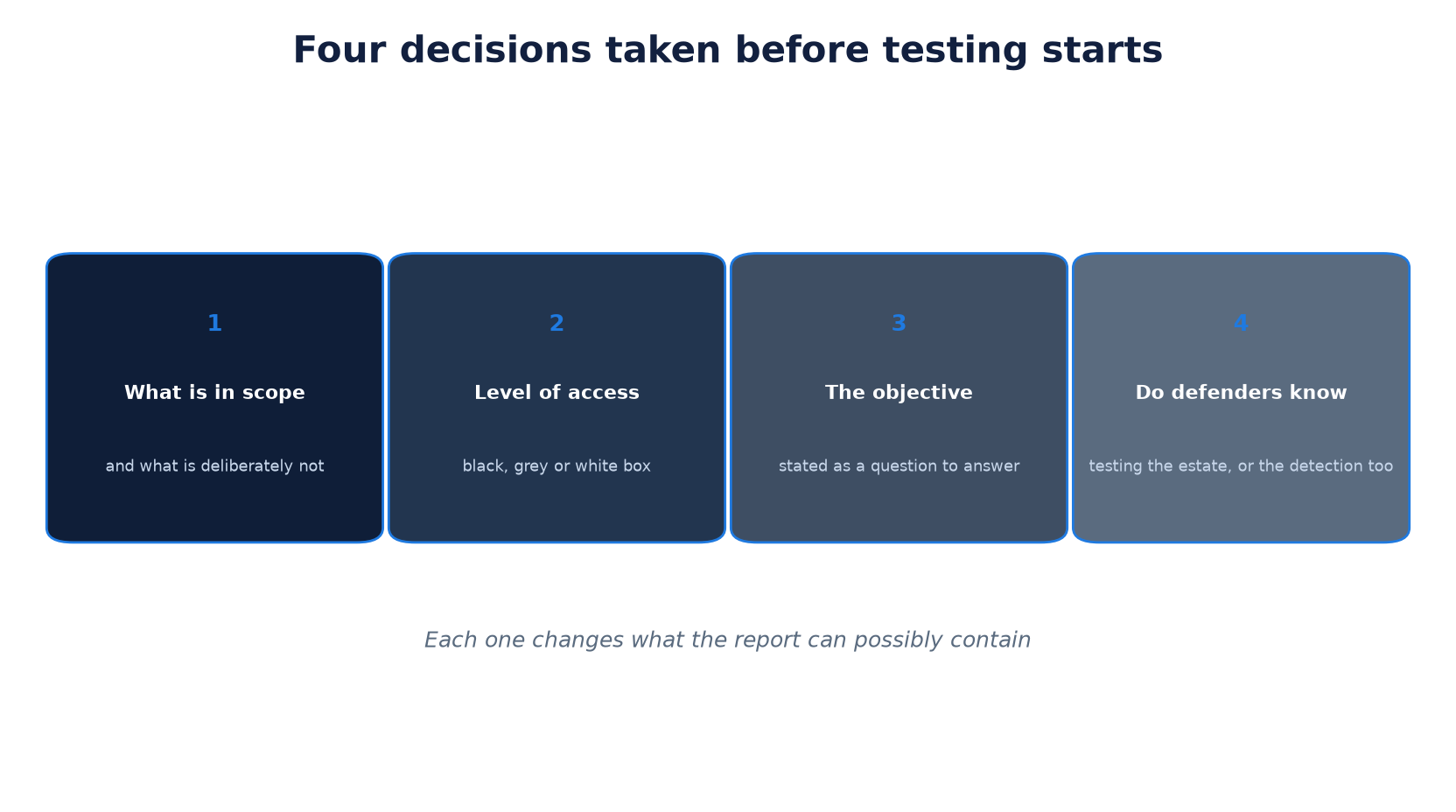
Diagram of the four scoping decisions that shape a penetration test
Four decisions taken before anyone starts testing. Each one changes what the report can possibly contain.
Choosing a tester
The market ranges widely in quality and the price signal is unreliable. Three things separate the good from the adequate.
Look for evidence of individual competence rather than only company accreditation. Schemes such as CREST and the NCSC’s assured schemes provide a floor, and the individuals assigned to your test matter more than the badge on the proposal.
Ask for a redacted sample report before buying. This is the single most informative step available and remarkably few buyers take it. You will learn immediately whether findings come with real reproduction steps and business context, or whether the report is scanner output with a cover page.
Ask what proportion of the engagement is manual. If the answer is vague, you are buying a scan.
Reading the report properly
Reports are usually read by severity, top down, until the criticals run out. That is the least useful order.
Read the methodology and scope first, because they tell you what the findings mean and what the absence of findings does not mean. Read the exclusions and any caveats about time or access. Only then read the findings.
Then apply the discipline this series applies to scanner output. A finding is an observation, not a risk. The report’s severity rating reflects technical severity in the abstract, and your rating should reflect exposure, asset criticality and what an attacker could actually reach in your environment. A critical on an isolated test system can reasonably be triaged below a medium on the customer portal, provided you write down why.
The findings people ignore
Medium and low findings are where the architecture quietly degrades. Individually they are unremarkable. Collectively they describe a pattern, and the pattern is usually the real finding. Three separate mediums about inconsistent authorisation checks are not three mediums, they are one design problem that will produce a critical eventually.
Read the report a second time looking only for patterns, and record what you see as a risk rather than as findings.
Acting on it
The remediation phase is where reports go to die. Three habits prevent it.
Convert findings into your own tracking system immediately, with owners and dates, rather than managing them in the report itself. A finding that lives only in a PDF is not being managed.
Retest, and insist that retesting is in the contract before you sign. A finding closed without verification is a finding closed on a developer’s word, which is usually right and occasionally not. The report plus the fix plus the retest evidence is the artefact an auditor and a customer both want.
Feed the themes into the register and into design. If the same class of finding appears in consecutive reports, the treatment is not another fix, it is a change to how things get built. That might mean a secure design pattern, a pipeline check or a training gap, and none of those come out of remediating individual tickets.
Frequency and what to test
Annual testing of everything is a common default and rarely the best allocation. Better patterns tie testing to change and exposure.
Test a significant new internet facing service before it goes live, not three months after. Test after major architectural change rather than on the anniversary. Test the crown jewels more often than the periphery. And use continuous scanning and pipeline checks to cover the ground between tests, so that the human effort goes where automation cannot reach.
The honest counterarguments
It is a snapshot and the estate changes daily
True, and it is why testing should never be the primary control. Its value is in finding classes of problem that automation misses, and in providing an independent view. Treating it as a periodic assurance activity rather than as protection sets the expectation correctly.
Reports are often scanner output with a mark-up
Frequently true at the cheaper end of the market, and the sample report request is the defence. This is a market where you genuinely get what you pay for, and where the cheapest quote often represents a different product entirely.
The compliance driver crowds out the security value
Many tests happen because a certification or a customer demands one, and a test bought to satisfy a clause will be scoped to pass rather than to learn. That is a real and common failure, and the fix is within your control. Nothing prevents you from scoping a compliance driven test to cover the thing you are actually worried about.
Common mistakes
Scoping to what is easy to test rather than what would hurt if compromised.
Treating the report’s severity ratings as your risk ratings without adjusting for your environment.
No retest, so closure is unverified.
Sharing the full report with customers. It is a map of your weaknesses, and this series has made the same argument about every other document that describes where you are weak. Share a summary or an attestation, not the reproduction steps.
Testing production without agreeing rules of engagement, out of hours windows and an emergency stop contact. This is rare and expensive when it goes wrong.
Where to start
Before your next test, spend an hour writing two or three concrete objectives and an explicit exclusions list, then send both to the tester and ask whether the scope will answer those questions. That conversation, which most buyers never have, changes the report you receive.
Then go back and read last year’s report, specifically the mediums. If the same theme appears in two consecutive years, you have found something more valuable than any individual finding, which is a design problem your remediation process was never going to fix.
Written by P Larner. Drafting and copy-editing were assisted by AI tools, and header images are AI-generated. All technical claims are the author's.
Run your GRC programme in your own network.
RaptorGRC Community Edition is free: every module, offline licence activation, nothing phones home.
Register / Download Contact us