BLOG
How to Protect Against Frontier AI: The Threat Outside and the Risk You Invite In
Published 7 August 2026 · By P Larner
Security in Practice#deepfake#shadow IT#self-hosting#artificial intelligence#phishing
Illustration for: How to Protect Against Frontier AI
In early 2024 a finance employee at the engineering firm Arup joined a video call with people who looked and sounded like the chief financial officer and several colleagues. Everyone on the call except the employee was synthetic. Around twenty five million dollars left the company in fifteen transfers. No system was breached, no malware ran, no control failed in the sense an auditor would recognise. A payment process that relied on recognising a face and a voice met a technology that can manufacture both.
That is the shape of the problem. Frontier AI arrives in your organisation from two directions at once, as capability in the hands of people attacking you, and as a system you deliberately install and connect to your own data. The controls differ, the owners differ, and most organisations are currently writing a policy about the second while losing money to the first.
What has actually changed
The NCSC published an assessment in 2024 that remains the most level headed summary available. Artificial intelligence will almost certainly increase the volume and impact of attacks, but the uplift is concentrated in social engineering and reconnaissance rather than in exotic new attack classes. Adversaries are not doing new things. They are doing familiar things faster, at greater volume, and with far better English.
This is a frequency change, not a novelty change
Every risk scenario in your register that begins with a convincing message or a plausible caller has just moved up the likelihood axis, and nothing in your controls needs replacing so much as re-rating. That is a comfortable conclusion for a risk practitioner and an uncomfortable one for anyone who was relying on typos and stilted grammar as a detective control.
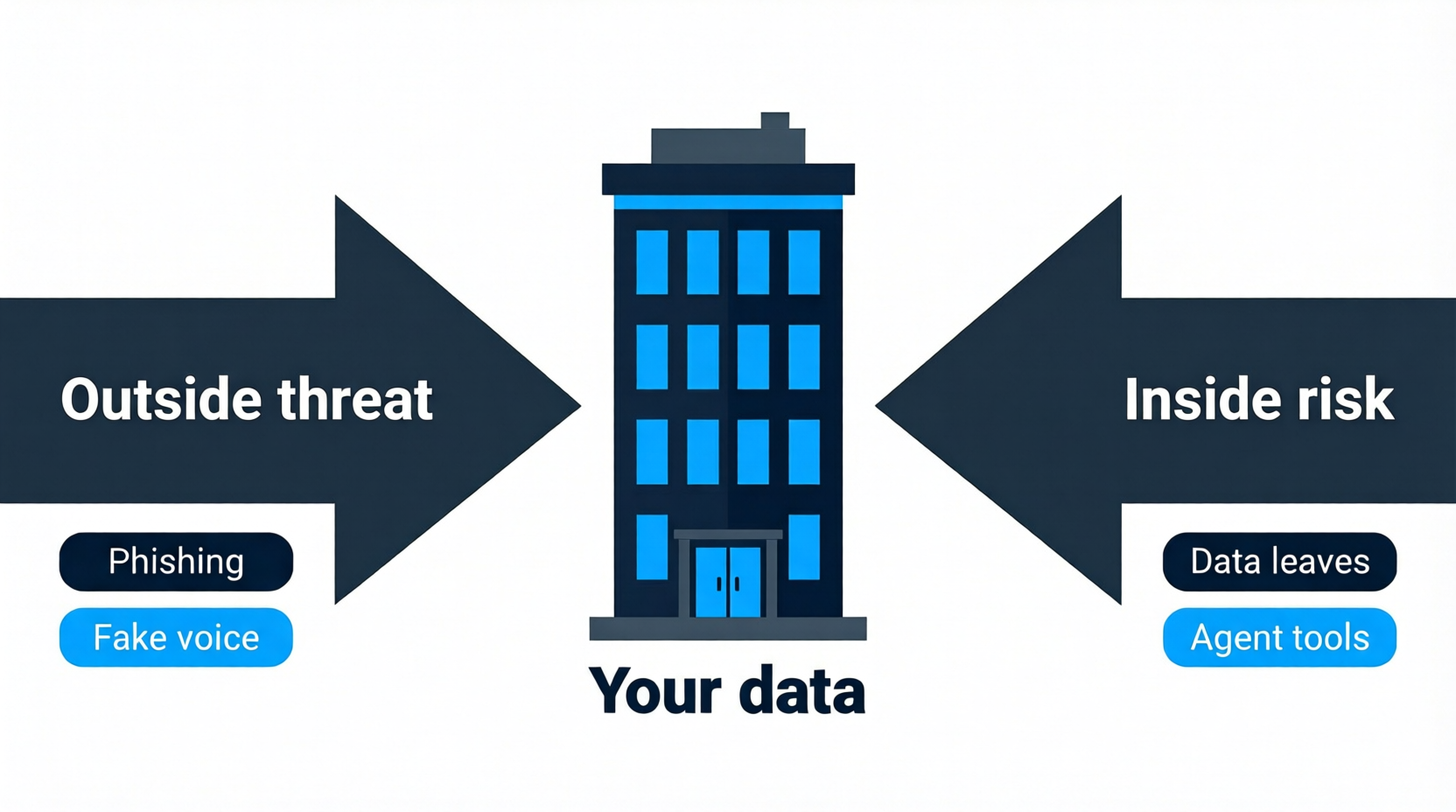
Diagram of two directions of exposure to advanced artificial intelligence
The same technology arrives twice, once as capability held by people attacking you and once as a system you connect to your own data. The two need different owners.
The attacker with a frontier model
Phishing no longer reads like phishing
Awareness training built around spotting bad spelling is now training people in a signal that has disappeared. Replace it. Teach staff to react to the request rather than the writing, because urgency, secrecy and a change of bank details remain reliable indicators when prose quality no longer is.
Reconnaissance is effectively free
A model can read your entire website, your filings, every LinkedIn profile of your staff and every conference talk your engineers gave, then produce a targeting pack in minutes. Information you published deliberately is now assembled against you automatically, which is worth remembering the next time somebody proposes a detailed case study naming your systems and suppliers.
Voice and video are no longer evidence of identity
The Arup case is the well documented one and it will not be the last. The control is procedural rather than technical. Payment and access changes need out of band verification through a channel the requester did not choose, a callback to a number from your own directory, and a rule that no single person can complete a novel payment path. Write it down and rehearse it, because the moment of the call is the wrong time to invent policy.
Vulnerability discovery gets faster on both sides
Models are demonstrably capable of finding flaws in code, which shortens the window between a patch appearing and an exploit existing. The defensive answer is unglamorous. Know your assets, know your exposure, and be able to patch an internet facing service in days rather than the quarter your change process currently allows.
What does not change
Multi-factor authentication that resists phishing, network segmentation, least privilege, tested backups and a rehearsed incident plan all work exactly as well against an adversary with a model as against one without. Nobody needs to buy an artificial intelligence defence platform to defend against artificial intelligence. They need the boring controls to actually be in place, which is a harder sell and a better use of money.
The model you bring inside
The second direction is quieter and it is where most organisations create their own exposure.
Every prompt is a disclosure
When a member of staff pastes a contract, a patient list or an incident report into a hosted model, that data has left your boundary and entered a supplier relationship that procurement never saw. Compliance and security data is the sharpest example, because a risk register or a control gap analysis is a map of exactly where to attack you, and this series has argued repeatedly that such a map belongs inside the network it describes.
Shadow adoption is the realistic breach
Staff are using these tools whether you have a policy or not, and a ban produces invisible use rather than no use. Give people a sanctioned route that is genuinely good enough to prefer, then monitor for the alternatives, because an approved tool with logging beats a prohibited tool without it in every scenario that ends in an investigation.
Agentic access is a privileged account with initiative
The moment a model is wired to tools, credentials and a task loop, it stops being a text service and becomes a user of your systems that acts faster than anyone can watch. Treat it as you would a new administrator. Scope what it may touch, give it its own identity rather than a human’s, require approval before anything irreversible, and log every action to somewhere it cannot edit.
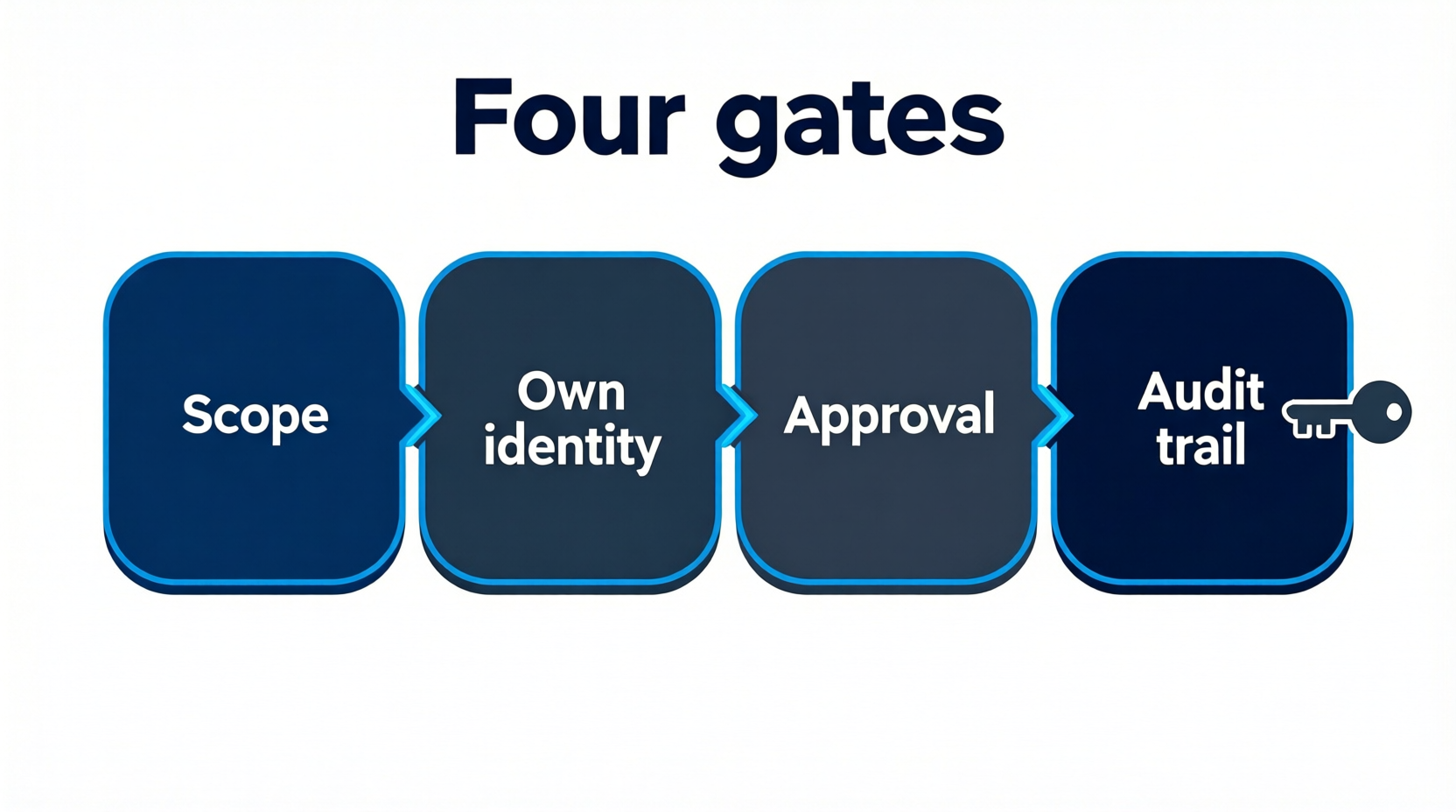
Diagram of four gates before an artificial intelligence agent receives access
Four gates before an agent is given credentials. None of these are new controls, which is the point.
Prompt injection has no clean fix yet
If a model reads untrusted content, that content can carry instructions. A document, a web page or an email can tell your agent to do something you never asked, and there is no filter that reliably prevents it. The mitigation is architectural rather than clever, which means constraining what the agent is able to do so that a successful injection reaches nothing that matters.
Evidence and audit are already behind
Ask three questions of any system involving a model. Can you show who decided, can you show what the system was told, and can you reproduce the answer six months later for a regulator. Where the honest answer is no, that system is not ready to make decisions about people, and the accountability principle in GDPR applies to automated decisions exactly as it applies to manual ones.
Self-hosting deserves a serious look
Open weight models running on your own hardware are now good enough for summarisation, classification, drafting and search across an internal corpus, which covers the great majority of real business use. The performance gap against the largest hosted models is real but it is narrowing, and for anything involving regulated or operationally sensitive data the trade is usually worth making. That is the same argument this series makes about GRC platforms and it survives the change of subject unaltered.
The honest counterarguments
Perhaps the threat is overstated
Predicted waves of AI-enabled attacks have repeatedly arrived as slightly better versions of the attacks we already had. Ransomware still gets in through unpatched edge devices and stolen credentials, not through anything clever, and an organisation that spends this year on model governance instead of asset management has optimised for the interesting risk over the likely one.
Perhaps self-hosting is the expensive answer
Running your own models means hardware, expertise and a capability you did not previously need, and a small organisation may reasonably conclude that a contract with a reputable supplier and a well drafted data processing agreement manages the risk more cheaply than a rack of accelerators. That is a defensible position when it is a decision rather than a drift.
Perhaps refusing is not available
Competitors using these tools will quote faster and write proposals more cheaply. The board will notice. Refusal is a strategy with a cost, and pretending otherwise is how security teams get routed around rather than consulted.
Common mistakes
Writing an AI policy and calling it a control
A policy that nobody can enforce technically is a statement of hope. Pair every clause with the mechanism that would detect a breach of it.
Assigning both halves to the same owner
The outward threat belongs with security operations and the fraud process. The inward risk belongs with procurement, data protection and whoever owns the systems being connected. One person owning both will do neither.
Assuming the supplier’s assurances cover you
A model provider’s safety framework governs the model. It does not govern the account your staff opened with a corporate card, and it says nothing about what your own agent did with the credentials you gave it.
Go back to the finance employee on that video call. Nothing in a firewall would have saved them. What would have saved them is a rule that says a payment instruction is verified out of band regardless of who appears to be asking, agreed in advance, written down, and rehearsed often enough that following it under pressure feels normal. That is the whole discipline in one sentence. The technology is new, the exposure is old, and the organisations that come through this well will be the ones that decided deliberately, in writing, which direction they were defending.
Run your GRC programme in your own network.
RaptorGRC Community Edition is free: every module, offline licence activation, nothing phones home.
Register / Download Contact us