BLOG
Insider Risk: The Control Set Nobody Wants to Own
Published 18 November 2026 · By P Larner
Security in Practice#DPIA#access control#UK GDPR#insider risk#employee monitoring#insider threat#leaver process

Illustration for: Insider Risk, The Control Set Nobody Wants to Own
Ask who owns insider risk in your organisation and watch the answer travel. Security says it is a people issue and points at HR. HR says it is a security issue and points back. Legal says it is both and reminds everyone about employment law. Nobody is wrong, and the risk sits in the gap between three functions that each believe somebody else has it.
That ownership vacuum is the actual problem. The controls are not especially difficult and the technology is not especially exotic. What is missing is a person who is accountable for the whole picture and a process the three functions have agreed in advance.
What insider risk actually covers
The term collapses three very different things, and treating them as one is why programmes get stuck.
The malicious insider acts deliberately, for money, grievance or on behalf of someone else. This is the rarest category and it dominates the conversation because it makes the best story.
The negligent insider causes harm through carelessness. They email the wrong attachment, use a personal account for convenience, or take a shortcut around a control that was making their job difficult. This is by far the largest category.
The compromised insider is not really an insider at all. Their credentials are being used by somebody else, and every control you have that watches user behaviour will see them as the actor.
The three need different treatments, and only the first is about a person’s intent. A programme designed entirely around catching malicious actors will spend most of its effort on the rarest case while the common one continues daily.
Why the distinction changes the controls
Negligent behaviour responds to friction removal and better defaults. Malicious behaviour responds to segregation, monitoring and the knowledge that monitoring exists. Compromise responds to identity controls and anomaly detection. A single control set built for one of those will underperform on the others, and worse, a programme sold internally as catching bad people will fail politically before it starts.
Deciding who owns it
The workable model gives one function the accountability and defines what the other two contribute. Which function holds it matters less than that somebody does, though the arrangement most likely to work is risk or security holding the accountability and HR holding the veto on anything touching an individual.
Function | Owns | Must not own |
|---|---|---|
Security or risk | The overall risk, the controls, the monitoring design, the referral threshold | Decisions about a named individual |
HR | Employment process, the response to a person, proportionality | The technical monitoring configuration |
Legal or data protection | Lawfulness of monitoring, the balancing assessment, evidence handling | The day to day operation |
Line management | Knowing their people, raising concerns, the local context | Investigating alone |
The row that prevents most disasters is the second one. Security should never be deciding what happens to a named person, and HR should never be configuring what gets monitored. When those two boundaries hold, the programme survives its first real case.
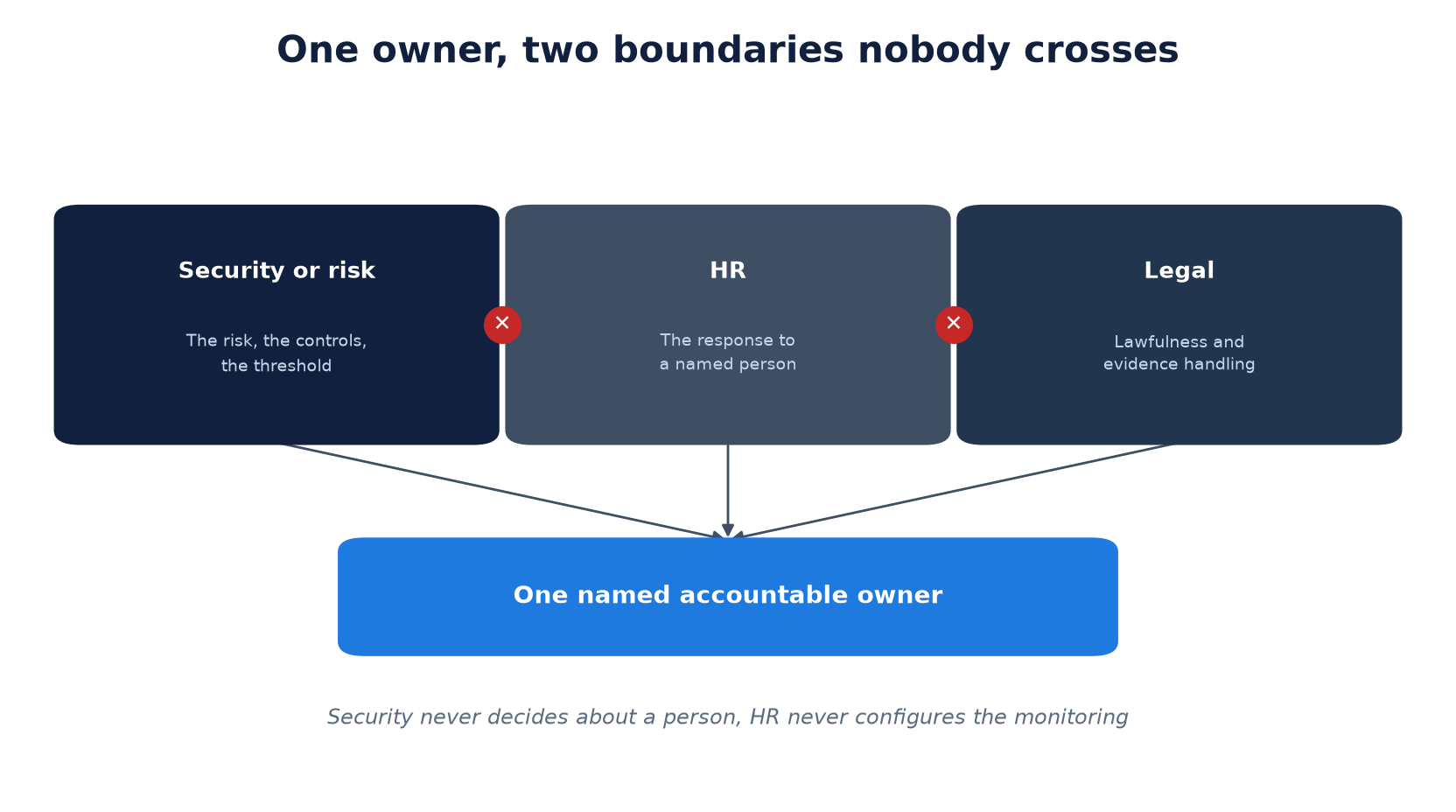
Diagram of the three functions and what each one owns in an insider risk programme
Three functions, one accountable owner, and two boundaries that must not be crossed. Most insider programmes fail at the join rather than at the control.
The controls that actually help
Strip away the vendor framing and the useful controls are mostly things you already have, applied with insider risk in mind.
Access proportionality is the foundation. Most insider harm requires access, and most organisations grant far more than the role requires. The joiner, mover and leaver problem covered in an earlier post in this series is the same control viewed from a different angle, and the mover case is where insider exposure quietly accumulates.
Segregation of duties limits what one person can complete alone, which is the whole point of the control and the reason it belongs in this conversation as much as in finance.
Logging that reaches somewhere the subject cannot alter is what turns suspicion into evidence. Without it you have a story.
Detection tuned for behaviour rather than content picks up the patterns that matter, such as bulk downloads before a resignation, access to material outside a person’s remit, or activity at unusual times from unusual places. None of these are proof of anything. All of them are worth a look.
And the leaver process is where more data leaves organisations than through any dramatic exfiltration. The month before a departure is the highest risk window in most employment relationships, and it is usually the window with the least attention.
The control people forget
Make the right thing easy. A meaningful share of negligent insider incidents happen because the sanctioned route was slower than the unsanctioned one. If sending a large file to a client properly takes twenty minutes and a personal file sharing account takes thirty seconds, you have designed the incident. This is cheaper than any monitoring tool and it addresses the largest category.
Monitoring, lawfully and proportionately
This is where programmes stall, and the caution is warranted. Monitoring employees is lawful in the UK when done properly and is a serious problem when done casually.
The practical requirements are consistent. Have a lawful basis and document it, which for most private sector monitoring means legitimate interests with a balancing assessment written down rather than assumed. Tell people, in plain terms, what is monitored and why, because covert monitoring is a much higher bar and is rarely justified for routine risk management. Be proportionate, which means monitoring the activity that matters rather than everything because the tool allows it. And run a data protection impact assessment before deployment rather than after, since this is exactly the kind of processing that warrants one.
The thing worth internalising is that proportionality is not only a legal test, it is what makes the programme survivable internally. A monitoring regime staff regard as surveillance will produce a culture where nobody reports concerns, and peer reporting is the highest value detection you have.
Thresholds and the referral route
The single most useful artefact in an insider risk programme is an agreed threshold document that says what triggers what. Without it, every case is negotiated from scratch under pressure, and the negotiation happens between functions with different instincts.
A workable structure has three tiers. Anomalies that generate a look by the analyst and usually resolve immediately with context. Concerns that trigger a documented referral to a small standing group of security, HR and legal. And cases that move into formal investigation with evidence handling, legal oversight and a defined route to disciplinary or law enforcement.
Agree in advance who sits in that standing group, how quickly it convenes, and what it is allowed to see. Doing that on a quiet afternoon is worth more than any tool, and it is the artefact most organisations lack when the first real concern arrives.
The honest counterarguments
It is a solution looking for a problem
Insider incidents are rarer than the vendor market implies, and a programme sized for a hostile state actor in a two hundred person marketing business is disproportionate. The fair response is that the negligent category is not rare at all, it is happening now, and the controls that address it are cheap. Size the programme to the common case and let the rare case borrow the same controls.
Monitoring corrodes trust
It can, and the corrosion is not evenly distributed. Staff tolerate monitoring they understand and resent monitoring they discover. The organisations that get this right publish what is monitored, explain why, apply it to everyone including executives, and never use it for performance management. The ones that get it wrong deploy quietly and are found out.
You cannot stop a determined insider
Broadly true, and it is not the objective. The objective is to make the common case less likely, to make the deliberate case harder and slower, and to ensure that when something does happen you can establish what occurred. Prevention is a bonus. Detection and evidence are the deliverable.
Common mistakes
Buying the tool first. Insider risk tooling produces a great deal of signal and is useless without an agreed threshold and a referral route, so the tool arrives and the alerts pile up unactioned.
Treating it as purely technical. The strongest indicators are usually behavioural and known to a line manager well before they appear in a log.
No process for the accusation that turns out to be wrong. Most concerns resolve innocently, and an organisation with no defined way to close a case without harming a reputation will stop raising them.
Excluding executives and administrators. The people with the most access are routinely exempted from monitoring for reasons of seniority, which inverts the risk.
Forgetting contractors and third parties. They frequently hold insider access with none of the employment framework, and the leaver process for a contractor is often nobody’s job.
Where to start
Do not start with monitoring. Start by naming the accountable owner, in writing, and getting security, HR and legal in one room for an hour to agree the three tier threshold and who sits in the standing group.
Then look at one thing, which is what your leavers can access in their final month and what they actually did. That single review is legal, proportionate, uses data you already hold, and is likely to find something in most organisations. It also gives the new standing group a real case to practise on, which is a considerably better introduction than waiting for one to arrive on its own.
Written by P Larner. Drafting and copy-editing were assisted by AI tools, and header images are AI-generated. All technical claims are the author's.
Run your GRC programme in your own network.
RaptorGRC Community Edition is free: every module, offline licence activation, nothing phones home.
Register / Download Contact us