BLOG
Post Quantum Migration: What to Do Before 2028
Published 25 October 2026 · By P Larner
Security in Practice#TLS 1.3#UK cyber security#NCSC#Quantum computing#Harvest now decrypt later#PQC migration#ML-KEM#Post quantum cryptography#Encryption#Crypto agility#Cryptographic inventory#Risk management

Illustration for: Post Quantum Migration, What to Do Before 2028
Post quantum cryptography occupies an awkward position in most organisations’ planning. It is simultaneously too distant to fund and too consequential to ignore, so it sits in the risk register as a single amber entry with no owner and no action, refreshed annually with the observation that the timeline remains uncertain.
The timeline is uncertain. What is not uncertain is that the migration is a multi-year programme touching almost every system, that the preparatory work is useful regardless of when the threat materialises, and that one specific category of data is exposed today rather than in the 2030s.
The threat, stated precisely
Shor’s algorithm, running on a sufficiently capable quantum computer, breaks the mathematics underlying the public key cryptography in general use. RSA, Diffie-Hellman and elliptic curve cryptography all fall to it.
Symmetric cryptography is affected far less. Grover’s algorithm offers a quadratic speedup against symmetric keys, and the NCSC’s position in its post quantum whitepaper is that existing symmetric algorithms with at least 128 bit keys, such as AES, can continue to be used.
The practical consequence is that the exposure concentrates in key exchange, digital signatures and certificates rather than in bulk encryption.
Harvest now, decrypt later
This is the part that makes the timing argument sharper than it first appears. An adversary can capture encrypted traffic today and store it, waiting for the capability to decrypt it later. The NCSC describes the same risk as an attacker “collecting and storing data today and decrypting it at some point in the future”.
That matters for anything with a long confidentiality lifetime. Health records, legal files, intellectual property, state secrets, long term contracts, personal data that remains sensitive for decades. Nobody can date the arrival of a capable quantum computer, and the NCSC itself says it is hard to predict. But suppose one arrives in 2035. If your data must stay confidential until 2045, then traffic captured in 2026 is exposed.
For data whose confidentiality lifetime is two years, the risk is close to zero. That distinction is what makes a proportionate plan possible.
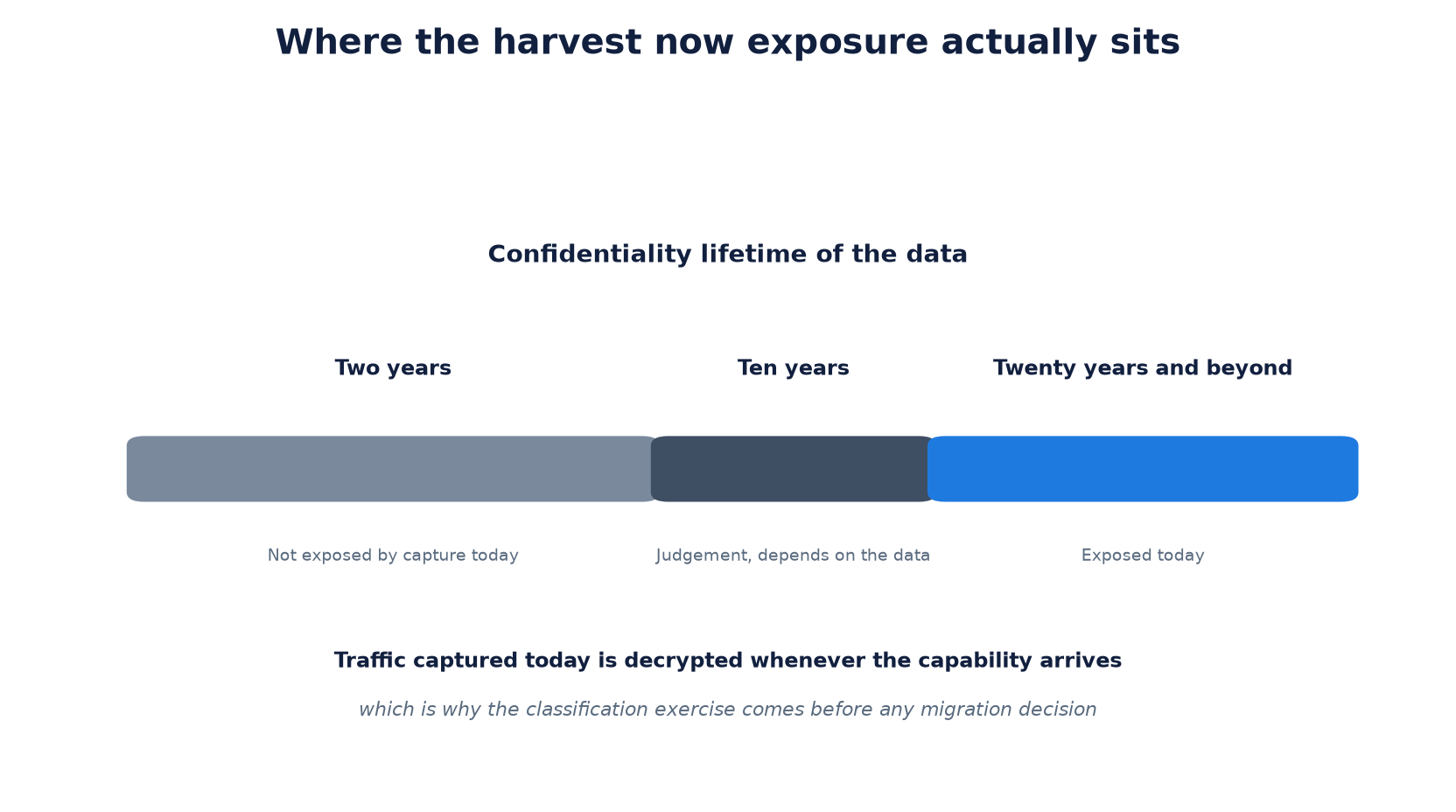
Diagram of confidentiality lifetime against exposure to harvest now decrypt later
Where the exposure actually sits. Data with a short confidentiality lifetime is not exposed by capture today, and data with a long one already is.
Where the standards are
The United States National Institute of Standards and Technology published its first three post quantum standards on 13 August 2024, at the end of a selection process it began in 2015. They are ML-KEM (FIPS 203) for key encapsulation, based on the CRYSTALS-Kyber submission, and ML-DSA (FIPS 204) and SLH-DSA (FIPS 205) for digital signatures, based on CRYSTALS-Dilithium and SPHINCS+ respectively. In March 2025 NIST selected a fifth algorithm, HQC, as a backup key encapsulation mechanism to ML-KEM. It rests on error correcting codes rather than lattices, and NIST expects to finalise its standard in 2027.
The practical significance is that the algorithms are settled enough to plan around. The NCSC recommends ML-KEM-768 and ML-DSA-65 for most use cases. It accepts hybrid key exchange, meaning a classical and a post quantum algorithm used together so that breaking either alone is insufficient, as an interim measure. For public key infrastructure it prefers a single migration straight to fully post quantum certificates over an intermediate hybrid stage. Implementations exist in the major cryptographic libraries, and hybrid key exchange is already deployed in major browsers and in some cloud provider connections.
In Britain, the National Cyber Security Centre published its migration timelines on 20 March 2025, setting out three milestones. By 2028, define migration goals, carry out a full discovery exercise and build an initial migration plan. By 2031, carry out the early, highest priority migration activities and refine the plan into a thorough roadmap. By 2035, complete migration of all systems, services and products.
These are guidance rather than law, and the NCSC aims them primarily at large organisations, critical national infrastructure operators and companies with bespoke IT. Smaller organisations on commodity IT should find most of the migration arrives through their suppliers, although custom software follows the same timetable. Those dates are still the anchor worth planning against, and the first of them is closer than most register entries acknowledge. Discovery complete by 2028 is a piece of work that starts now in a large estate.
What to do now, proportionately
Find out where your cryptography is
This is the whole of the useful work available today, and in my experience few organisations have done it.
A cryptographic inventory records where public key cryptography is used, for what, with which algorithms and key sizes, and who owns it. Certificates and their issuers. Virtual private network and transport layer security configurations. Code signing. Document signing. Anything with an embedded root of trust. Hardware security modules. Third party services whose cryptography you inherit.
The exercise is unglamorous, it takes months in a large estate, and it is the prerequisite for every subsequent decision. It also produces immediate value, because the inventories I have seen almost always turn up expired certificates, unowned keys and deprecated algorithms in current use.
Classify by confidentiality lifetime
For each data set, how long must it remain confidential? My working threshold is ten years. Anything above it belongs in the harvest now category and at the front of the queue. The NCSC asks for the same thing in its discovery guidance, a record of the data you hold with its expected lifetime and its value to an adversary.
This is a business classification exercise rather than a technical one, and it is the step that converts an undifferentiated problem into a prioritised one.
Ask your suppliers
Most of your cryptography is somebody else’s. Cloud providers, software vendors, hardware suppliers and certificate authorities all have roadmaps, and asking for them now does two useful things. It tells you which parts of the estate will migrate without your effort, and it signals demand. Where managed service providers run most of your IT, the NCSC’s timelines guidance expects you to confirm they are doing the same assessment for the services they provide.
Build crypto agility
The most durable investment. Systems where the algorithm is a configuration parameter rather than a hard coded assumption will migrate cheaply, and systems where it is embedded will need rebuilding.
Agility is worth pursuing on its own terms, because this will not be the last migration, and organisations that could not move from SHA-1 quickly are the ones that will struggle again.
Move to TLS 1.3 and enable post quantum key exchange
Low cost, low risk, and it addresses the harvest now exposure for traffic in transit. The NCSC’s updated TLS guidance, published on 15 October 2026, is blunt about the prerequisite. TLS 1.3 is the only version that supports post quantum cryptography, and earlier versions will not be upgraded. It recommends both hybrid and pure post quantum key exchange options and says organisations “should be aiming to make this move now”. Where your provider or library offers it, turning it on is usually a configuration change rather than a project. Where you are still on TLS 1.2, the upgrade is the project.
What not to do yet
Two things are worth resisting.
Do not rip out working cryptography. Classical algorithms are not broken today and replacing them wholesale before implementations mature introduces risk without addressing exposure. The NCSC’s own advice is to use only robust implementations of the final standards and to plan upgrades into broader technology refreshes where possible.
And do not buy quantum key distribution as a solution to this problem. It addresses key exchange over dedicated optical links, it does not address signatures or the wider estate, and the NCSC’s August 2025 paper on quantum networking technologies says it will not support quantum key distribution for government or military applications. The same paper calls post quantum cryptography “the best mitigation” to the quantum threat.
The honest counterarguments
The timeline is speculative and this is vendor driven
Both partly true. Nobody can date the arrival of a cryptographically relevant quantum computer, and there is a marketing industry attached to this subject. The rebuttal is that the recommended action is a cryptographic inventory and crypto agility, both of which are worth doing regardless. If the threat never materialises, an organisation that knows where its cryptography lives and can change algorithms quickly has still improved.
Our data is not sensitive enough for this to matter
Quite possibly right, and it is a conclusion that should be reached through the confidentiality lifetime exercise rather than assumed. Most organisations hold at least a small category with a long lifetime, frequently in human resources or legal files, and the point of classifying is to find it.
It will be handled by our suppliers
Substantially true for cloud services and standard software, and the NCSC says as much for smaller organisations on commodity IT. It is not true for anything you built, anything embedded, anything with a hard coded certificate, or any long lived signature. The supplier roadmap question is a genuine part of the plan and it is not the whole of it.
Common mistakes
A single amber register entry with no owner, which is where this subject sits in most organisations I see.
No cryptographic inventory, which makes every subsequent decision unmakeable.
Treating it as uniformly urgent or uniformly distant, when the correct answer varies entirely by confidentiality lifetime.
Ignoring signatures and long lived certificates, which have their own timeline problem because a certificate issued today may still be trusted in a decade.
Hard coding new algorithms, which reproduces the agility problem in the replacement.
Buying quantum key distribution in the belief that it addresses this.
Where to start
Pick the data sets that must remain confidential for more than ten years and list them. In most organisations that is a short list and it is not empty.
Then find out how that data is protected in transit today, whether those paths already run TLS 1.3, and whether post quantum key exchange is available on them. Those two steps take a few weeks of internal effort rather than a budget line, and they convert an amber entry with no owner into a specific piece of work with a rationale that survives a challenge about the timeline.
Written by P Larner. Drafting and copy-editing were assisted by AI tools, and header images are AI-generated. All technical claims are the author's.
Run your GRC programme in your own network.
RaptorGRC Community Edition is free: every module, offline licence activation, nothing phones home.
Register / Download Contact us