BLOG
Q-SLICE: Threat Modelling for the Quantum Era
Published 27 October 2026 · By J Green
Security in Practice#PQC#Quantum computing#QUANTA#Harvest now decrypt later#threat modelling#Q-SLICE#Crypto agility#security architecture#post quantum#STRIDE
Illustration for: Q-SLICE, Threat Modelling for the Quantum Era
Quantum computing does not simply introduce another vulnerability for security teams to add to the risk register. It challenges some of the assumptions on which modern cyber security and threat modelling are built. Q-SLICE was developed to provide security architects and threat modellers with a practical way of bringing those emerging threats into the design process today. Threat modelling is one of the most useful things we do in security architecture. At its simplest, we look at a system, understand what we are trying to protect, identify how an adversary might attack it and decide what controls are required. Models such as STRIDE have helped security teams bring consistency and structure to this process.
The problem is that the technology landscape is changing. Quantum computing introduces threat scenarios that do not always fit neatly into the assumptions underpinning traditional models. For an organisation thinking about systems expected to remain secure for ten, twenty or thirty years, this is no longer simply an academic discussion. That was the problem that led me to develop Q-SLICE.
Why another threat model?
Q-SLICE is not intended to replace STRIDE, PASTA, VAST, MITRE ATT&CK or other established approaches. It is designed to operate alongside them, adding an additional quantum-focused layer to an existing threat-modelling process. That distinction matters, as classical cyber security remains relevant in a post-quantum world. Attackers are not suddenly going to stop exploiting weak identities, vulnerable applications, misconfigurations or poor supply-chain controls because sufficiently capable quantum computers have arrived.
The attack surface becomes broader as quantum computing can affect cryptographic assumptions, long-lived information, hybrid classical-quantum infrastructure and potentially the physical characteristics of quantum systems themselves. Q-SLICE therefore asks practitioners to consider threats which may otherwise sit outside a conventional threat model.
The six Q-SLICE threat categories
Q-SLICE structures quantum-era threats into six categories. Each focuses on a distinct way in which quantum technologies, quantum-enabled adversaries or the transition towards post-quantum security could affect a system. Covering off both attacks to and from quantum systems.
Q – Quantum Exploitation
Threats where quantum computational capabilities are used to undermine existing security mechanisms, particularly cryptography such as Shor’s and Grover.
Example: using quantum algorithms to attack cryptographic protections that were designed around classical computational limits.
S – Subversion of Trust
Threats targeting the mechanisms and technologies on which quantum or post-quantum trust depends. This includes QKD manipulation, QRNG compromise and subversion of roots of trust or PQC implementations.
Example: compromising a quantum random number generator so that security-critical randomness can no longer be trusted.
L – Legacy Exploitation
Threats that exploit continued dependence on legacy cryptography and protocols as organisations transition towards quantum-resistant systems. This includes Harvest Now, Decrypt Later and risks introduced by hybrid migration.
Example: capturing encrypted information now and retaining it for decryption when sufficient quantum capability becomes available.
I – Integrity Disruption
Threats intended to undermine the integrity of quantum, classical or hybrid systems. These include quantum-state tampering, AI model poisoning and corruption across hybrid environments.
Example: manipulating part of a hybrid quantum-classical system so that its processing or results can no longer be trusted.
C – Coherence Attacks
Threats directed at the properties that allow quantum systems to operate correctly. Q-SLICE includes decoherence induction, measurement manipulation, side-channel timing exploits and quantum communication interception within this category.
Example: deliberately interfering with a quantum system to induce decoherence and disrupt its expected operation.
E – Ecosystem Abuse
Threats that exploit the wider ecosystem surrounding quantum and post-quantum technologies. This includes post-quantum transition manipulation, cloud-hosted PQC module exploitation, AI-quantum interdependencies and systemic dependencies.
Example: compromising a cloud-hosted PQC component on which otherwise quantum-resilient systems depend.
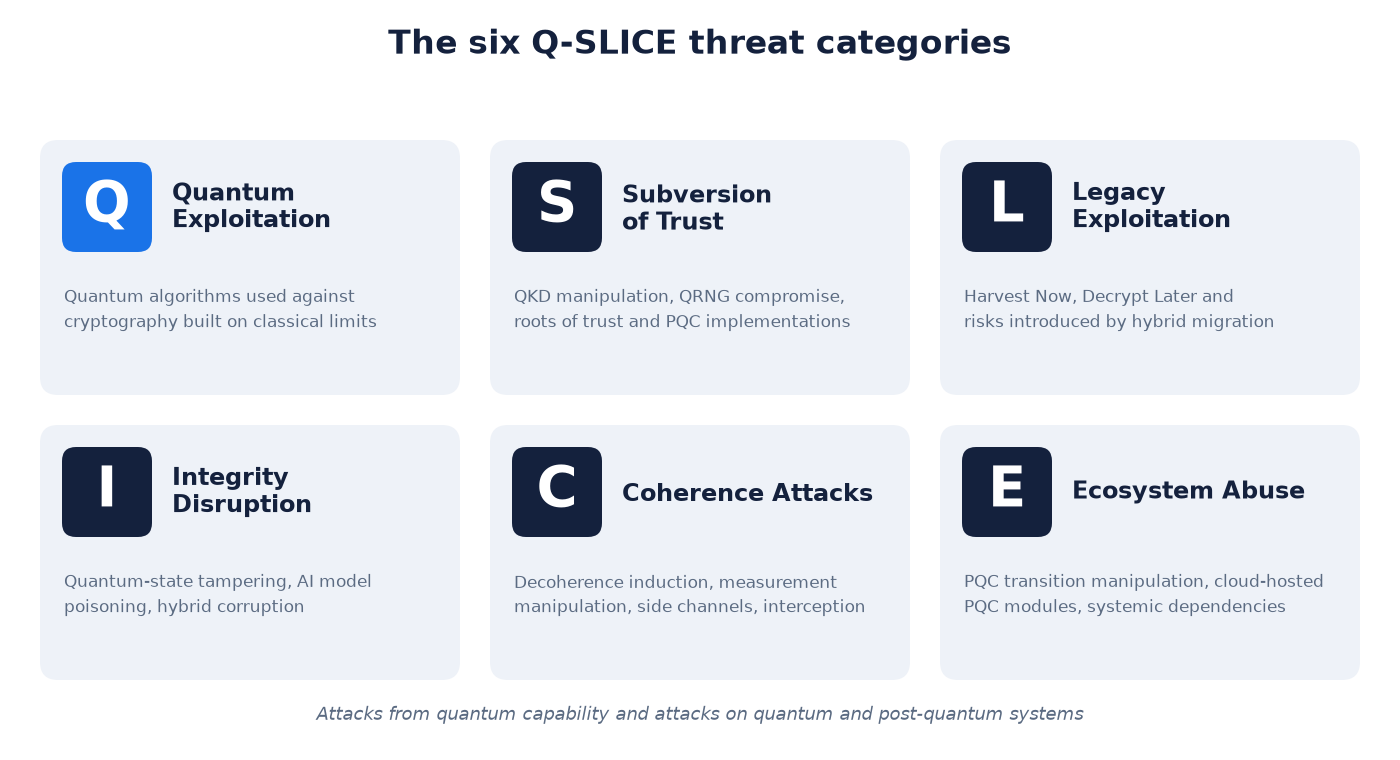
The six Q-SLICE threat categories, Quantum Exploitation, Subversion of Trust, Legacy Exploitation, Integrity Disruption, Coherence Attacks and Ecosystem Abuse, each with the threats it covers
Six lenses on one architecture. The categories cover attacks that use quantum capability and attacks on the quantum and post-quantum systems themselves.
The important part is not simply the acronym. Q-SLICE provides six distinct lenses through which an architecture can be examined for threats that conventional threat models may not explicitly capture. It considers not only quantum computational attacks, but also trust, legacy technology, integrity, coherence and the wider technology ecosystem.
The threat may exist before the quantum computer does
One of the hardest aspects of quantum security is explaining why organisations should care about a technology that may not yet be capable of breaking their production cryptography. Consider information being encrypted today that must remain confidential for another fifteen or twenty years. An adversary does not necessarily need the ability to decrypt it today. They need the ability to collect it today and decrypt it later. This is the Harvest Now, Decrypt Later problem. The security decision therefore cannot be based solely on whether a cryptographically relevant quantum computer exists at the point at which the risk assessment is performed.
The relevant question becomes: How long must this information remain secure and could the cryptography protecting it become vulnerable during that period? That brings quantum security into architecture decisions today.
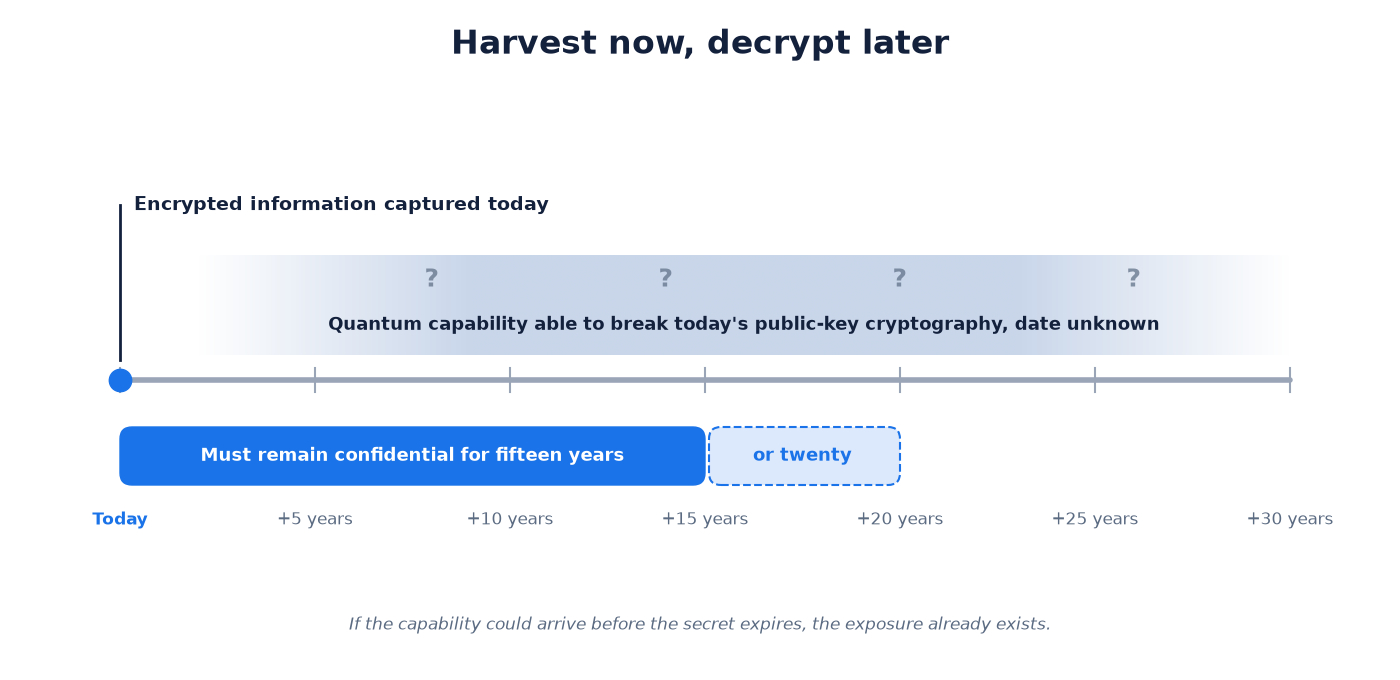
Timeline showing encrypted information captured today, a confidentiality requirement of fifteen or twenty years, and an undated band of uncertainty for when quantum capability could break public-key cryptography
The adversary only needs to collect today. If the capability could arrive while the information still matters, the exposure is already real.
Where conventional threat modelling develops blind spots
STRIDE remains extremely valuable, but it was not designed specifically around quantum systems or future quantum-enabled cryptanalysis. Q-SLICE consequently extends rather than replaces it. The research identifies several areas requiring additional consideration, including cryptanalytic advances associated with algorithms such as Shor's and Grover's, legacy cryptographic exposure, hybrid quantum-classical attack surfaces and physical-layer threats associated with quantum technologies.
Imagine conducting a threat model for a system handling sensitive information. A conventional exercise might examine spoofing, tampering, repudiation, information disclosure, denial of service and elevation of privilege.
Those are still valid questions and Q-SLICE adds others:
- What happens if the public-key cryptography protecting this system becomes vulnerable during the lifetime of the data?
- Where are the legacy algorithms and protocols we cannot quickly replace?
- Do third-party products prevent us from changing cryptography?
- Are we dependent on a supplier's post-quantum migration timetable?
- Could encrypted information captured today remain valuable to an adversary years from now?
- Are future hybrid or quantum components introducing new infrastructure or trust dependencies?
These questions change the threat model from “Can this system be attacked today?” to include “What conditions could make this system vulnerable during its operational lifetime?” That is a much more useful question for architecture.
Threat modelling for uncertainty
There is also a broader problem with quantum security. As nobody can give an organisation a reliable date for when a sufficiently capable quantum computer will threaten today's public-key cryptography. Trying to turn that uncertainty into a precise date can create false confidence. If the predicted date is far enough away, migration gets deferred. If the predicted date moves closer, organisations discover that cryptographic migration involves significantly more than replacing an algorithm.
Q-SLICE instead provides a way of modelling the conditions under which harm could occur. This thinking feeds directly into QUANTA, the associated quantum-security framework, which uses condition-based reasoning rather than relying on a forecast of when an attack will happen. Together, Q-SLICE identifies and structures the conditions under which quantum-enabled adversaries could cause harm, while QUANTA translates those conditions into organisational controls and measurable readiness. Its scoring model assesses Quantum Exposure (QES), Crypto-Agility (CAS) and Transition Readiness (TRS), providing a way to quantify technical exposure, the ability to adapt cryptography and organisational preparedness for migration.
Making the theoretical measurable
A threat model is of limited value if it exists only as an interesting diagram. A major part of Q-SLICE research has therefore been concerned with whether quantum threats can be tested and observed. The Q-SLICE Threat Harness uses Qiskit and real IBM quantum hardware to represent Q-SLICE threat categories as measurable test cases. The testing establishes baselines, introduces controlled adversarial conditions and measures resulting changes using metrics including fidelity, leakage, bias, quantum bit error rate and exploitation depth.
This matters because one danger surrounding quantum security is allowing the subject to remain entirely theoretical. Threat modelling should ultimately lead to something that can be examined, tested or controlled.
Start with architecture, not Q-Day
Organisations do not need to know exactly when Q-Day will arrive before they can start understanding quantum risk. They can already identify:
- where cryptography exists;
- which data has long confidentiality requirements;
- which systems depend on vulnerable cryptographic approaches;
- which dependencies cannot easily be changed;
- where suppliers control cryptographic decisions;
- and how easily architectures can transition to new algorithms.
That information is valuable regardless of the eventual quantum timeline.
This is also why Q-SLICE is an extension of normal security architecture rather than a specialist exercise that should sit with a separate “quantum team”. If you already threat-model important systems, quantum should increasingly become another dimension considered within that process.
From threat model to threat harness
Q-SLICE was designed to go beyond identifying and categorising quantum threats. A key part of development was the Q-SLICE Threat Harness, developed to test whether the six threat categories can be represented through observable and measurable behaviour in a simulator and then on small scale quantum processor. The Threat Harness uses Qiskit and real IBM quantum hardware to map each Q-SLICE category to a practical test case. It establishes a baseline, introduces controlled adversarial conditions and measures the resulting changes using metrics including fidelity, leakage, bias, quantum bit error rate (QBER) and exploitation depth.
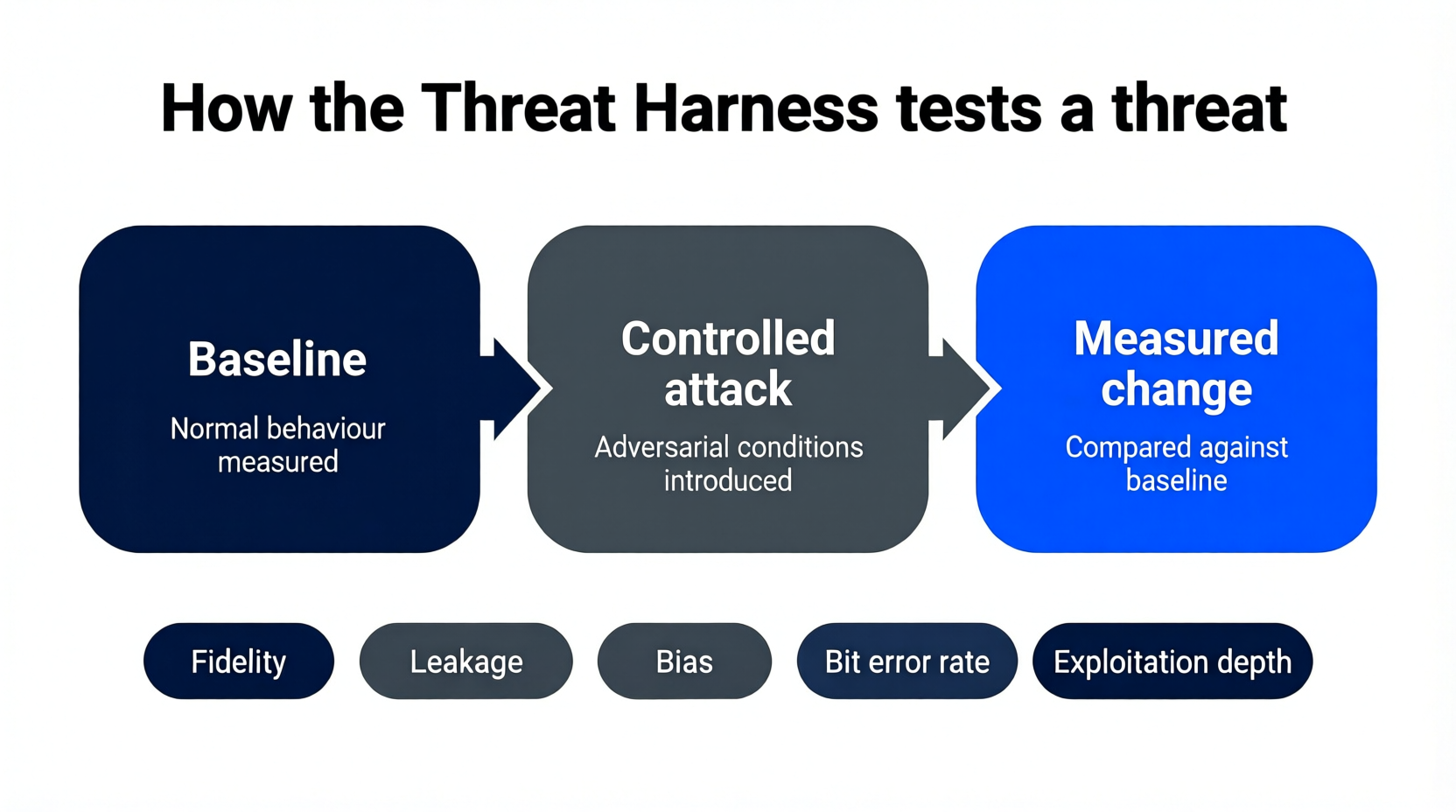
Process diagram of the Q-SLICE Threat Harness, moving from a measured baseline to controlled adversarial conditions to a measured change, scored on fidelity, leakage, bias, bit error rate and exploitation depth
Each category becomes a repeatable test. Measure the baseline, introduce the adversarial condition, and record how far the behaviour moves.
This is important because quantum threat modelling can easily remain theoretical. The Threat Harness provides a structured and reproducible way of examining the threats represented by Q-SLICE and comparing their measurable effects. In the underlying research, the six categories are brought together within a single testing framework so that results can be consistently compared and analysed. That is ultimately where Q-SLICE moves beyond being an acronym or conceptual threat taxonomy. It provides a structured way to identify quantum-era threats and a Threat Harness through which those threat categories can be practically examined and tested.
The Q-SLICE threat harness is publicly available on a GitHub repository: https://github.com/cyberjez/Q-SLICE
Run your GRC programme in your own network.
RaptorGRC Community Edition is free: every module, offline licence activation, nothing phones home.
Register / Download Contact us