BLOG
QUANTA: Turning Quantum Risk into Something Organisations Can Govern
Published 27 October 2026 · By J Green
Security in Practice#PQC#QUANTA#Harvest now decrypt later#governance#Q-SLICE#Crypto agility#Cryptographic inventory#security architecture#post quantum#quantum risk
Illustration for: QUANTA, Turning Quantum Risk into Something Organisations Can Govern
Quantum security is frequently presented as a cryptography problem. In practice, replacing vulnerable algorithms is only one part of the challenge. Organisations also need to understand their assets, dependencies, suppliers, architectures, governance and ability to migrate. QUANTA was developed to turn that broader quantum problem into a structured security and governance framework.
There is a temptation when discussing quantum security to reduce the problem to one sentence: Replace today's vulnerable cryptography with post-quantum cryptography. Technically, that direction makes sense, however, operationally, it is nowhere near enough. Cryptography is embedded throughout modern organisations: applications, identity systems, certificates, APIs, networks, cloud services, devices, software dependencies and third-party services. Even identifying all of it can be difficult and then changing it can be harder still. This makes the transition to quantum resilience as much a governance and security architecture problem as a cryptographic one.
From threat to control
QUANTA, or Quantum Universal Architecture for Next Gen Threat Assurance, is designed as a modular security-control architecture for organisations preparing for quantum-related threats. Its relationship with Q-SLICE is deliberate. Q-SLICE provides the threat-modelling layer. It asks where quantum-related harm could arise. QUANTA the asks the next question. “What are we going to do about it?“
The framework contains 40 controls spanning eight functional domains and maps those controls to established approaches including NIST Cybersecurity Framework 2.0, CIS Controls v8 and ISO/IEC 27001:2022.
The eight domains are:
- Cryptographic Resilience
- Governance and Risk
- Security Architecture and Design
- Monitoring and Assurance
- Training and Awareness
- Supply Chain Dependencies
- Data Protection and Confidentiality
- Framework Alignment.
The intention is not to ask organisations to throw away their existing security programmes.
Quite the opposite.
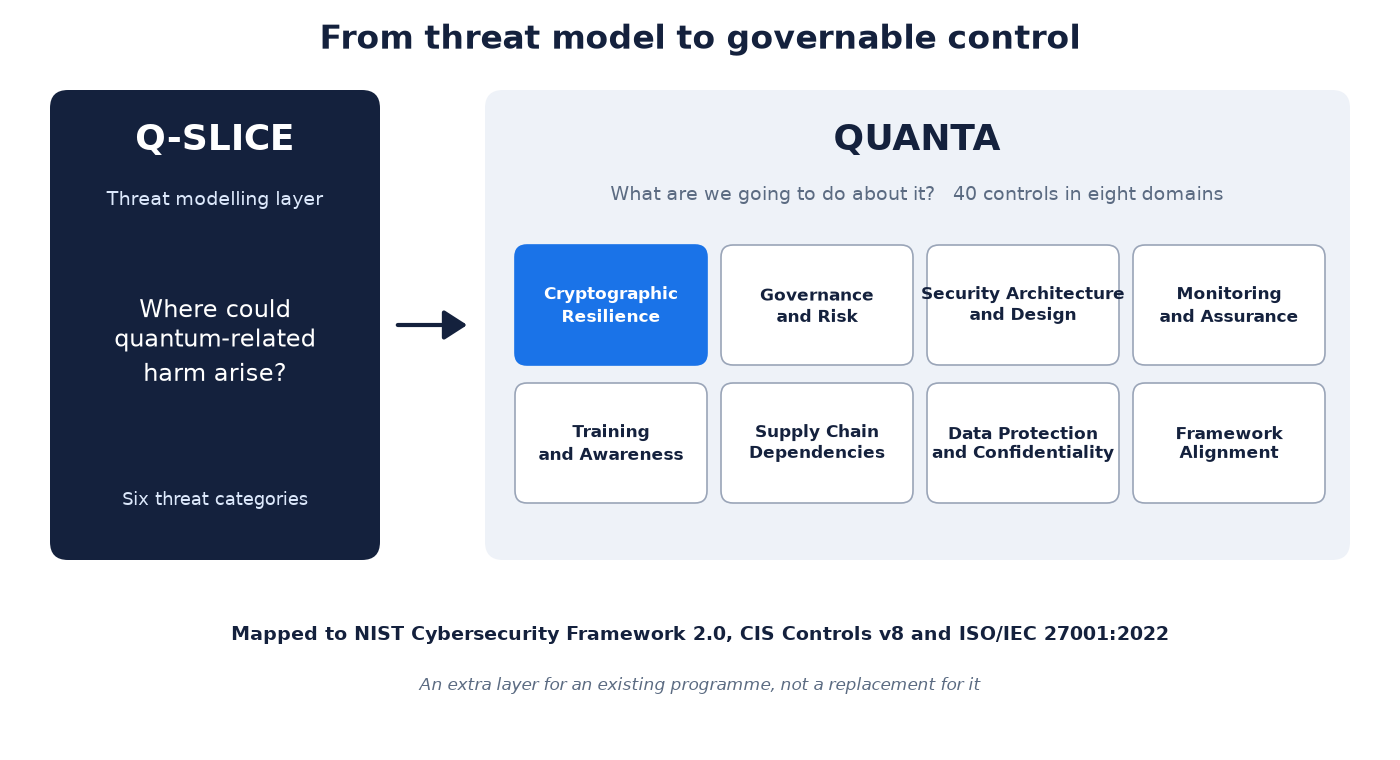
Diagram showing Q-SLICE as the threat modelling layer feeding QUANTA, a framework of 40 controls in eight domains mapped to NIST CSF 2.0, CIS Controls v8 and ISO/IEC 27001:2022
Q-SLICE finds where quantum harm could arise and QUANTA decides what to do about it. Both are built to sit on top of an existing programme.
The Lego Security approach
I describe the design principle behind QUANTA as Lego Security, as Lego model can be built according to the instructions, but the individual components remain usable independently and can be assembled in different ways. Security frameworks should be capable of operating in much the same way. Organisations differ enormously in size, technical maturity, regulation, risk exposure and existing architecture. A large financial institution is not going to have the same quantum-security journey as a smaller organisation running a handful of critical systems.
QUANTA's controls are therefore intended to be independently deployable and collectively composable. The framework can be adopted incrementally, integrated selectively with existing security frameworks, or used more broadly as a quantum-resilience architecture. That modularity is important because quantum migration is unlikely to happen as a single project, it is a transition.
Start with what you actually have
Before an organisation can talk seriously about migration, it needs to understand its current exposure.
- Where is cryptography being used?
- Which algorithms?
- Which certificates and keys?
- What information is being protected?
- How long must that information remain confidential?
- Which systems can be upgraded?
- Which cannot?
- Which suppliers control the technology?
This asset and cryptographic discovery problem is fundamental to QUANTA. The framework requires organisations to maintain inventories of assets and data, identify dependence on quantum-vulnerable cryptography and classify information according to its confidentiality lifespan. This also brings Harvest Now, Decrypt Later into prioritisation. Two systems using exactly the same cryptographic algorithm may have very different quantum risk. One may protect short-lived operational data. The other may hold information that must remain confidential for decades. Treating them as identical because their current encryption is identical misses the real exposure.
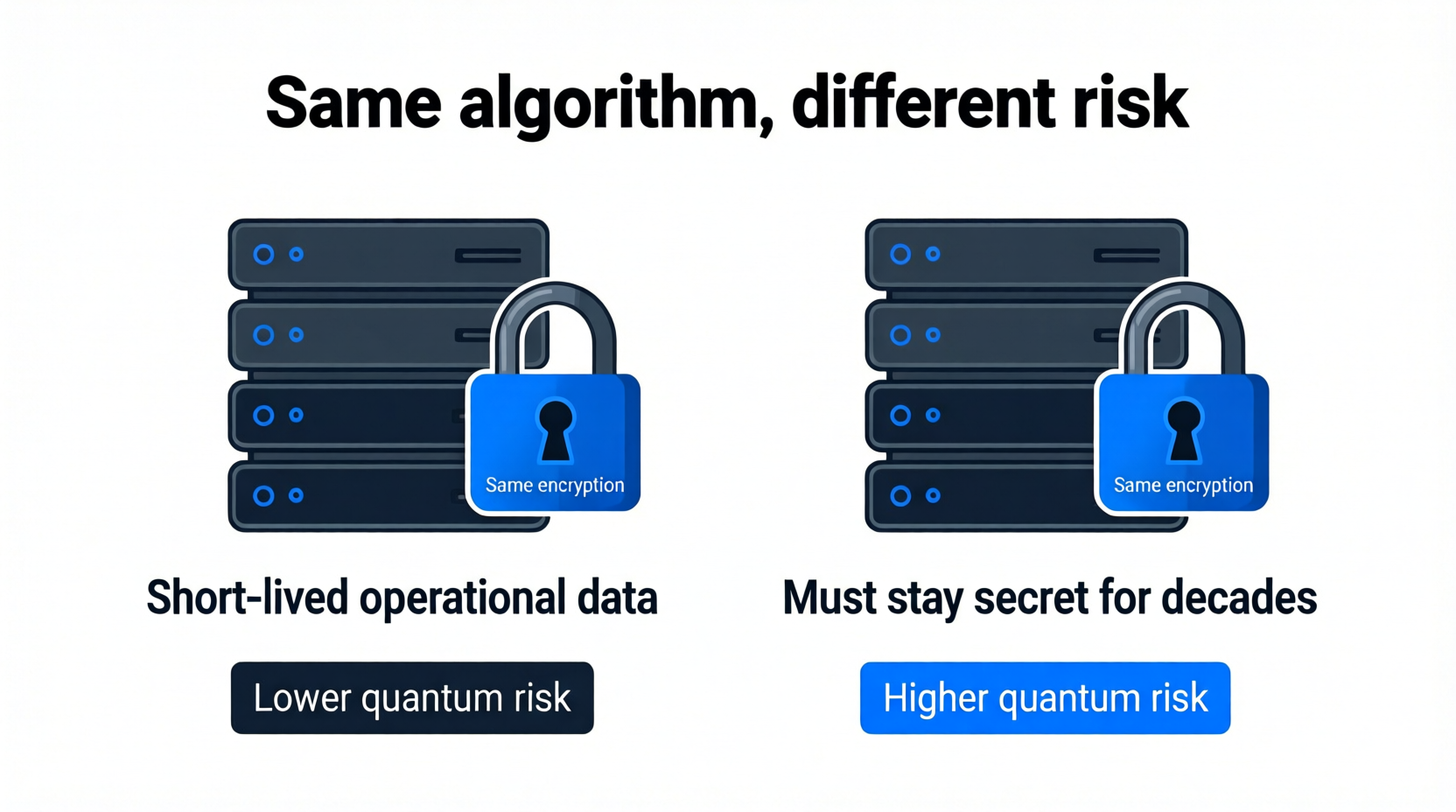
Two servers using the same encryption, one holding short-lived operational data at lower quantum risk and one holding information that must stay secret for decades at higher quantum risk
The algorithm is the same on both sides. What changes the risk is how long the information has to stay secret.
Crypto-agility matters as much as the algorithm
One of the most valuable outcomes from preparing for post-quantum cryptography may have relatively little to do with quantum computers. It forces organisations to confront cryptographic agility.
- Can algorithms be changed without redesigning an application?
- Can keys and certificates be replaced at scale?
- Are cryptographic dependencies known?
- Can protocols be upgraded?
- Does a supplier control the change?
- Are algorithms hard-coded into legacy applications?
QUANTA treats this ability to adapt as a measurable aspect of readiness.
Its scoring model connects Quantum Exposure Score (QES), Crypto-Agility Score (CAS) and Transition Readiness Score (TRS) to groups of controls addressing technical cryptographic exposure, architectural agility and governance/migration preparedness respectively. That creates an important distinction. An organisation can understand that it is exposed yet still be incapable of changing quickly. Knowing both is much more useful than simply knowing that RSA or ECC exists somewhere in the estate.
Quantum risk belongs in governance
The second major issue is ownership. As Quantum risk cannot remain solely with cryptographers or security engineers if addressing it requires multi-year technology changes, supplier engagement, investment and changes to enterprise architecture. QUANTA therefore explicitly includes governance. The underlying research addresses quantum-focused threat modelling, enterprise risk integration, cryptographic migration planning, supplier readiness and organisational oversight. It also treats Harvest Now, Decrypt Later exposure and the sensitivity and longevity of information as inputs into prioritisation.
This moves the discussion away from“Do we need post-quantum cryptography?” and towards: “Which parts of the organisation are exposed, what is the consequence, how difficult will migration be and who owns the decision?” That is a question a governance structure can actually work with.
Security under uncertainty
There is another principle behind QUANTA that I believe is particularly important.
Security professionals are used to likelihood and impact matrices. But emerging technologies create situations where meaningful probability can be extremely difficult to establish. How likely is a cryptographically relevant quantum computer by a particular date? Different people will give different answers. QUANTA therefore focuses heavily on conditions and possibility rather than attempting to manufacture certainty from an uncertain timeline.
The framework asks “Under what conditions does this failure become possible?“ If sensitive information has a twenty-year confidentiality requirement, uses quantum-vulnerable cryptography and can be collected by an adversary today, the organisation already has conditions worth governing.
We do not need to assign an arbitrary percentage probability to Q-Day before taking that exposure seriously.
Similarly, if a critical legacy platform cannot change its underlying cryptography without being replaced, that fragility exists today. The quantum computer does not create the architectural fragility. It exposes it.
From resilience to fragility
This leads to another important principle in QUANTA, fragility. Traditional cyber resilience understandably places substantial emphasis on being able to withstand an incident and recover afterwards. But not every security failure can be reversed. If long-lived confidential information is captured and subsequently decrypted, restoring a system does not restore the secrecy of that information.
The confidentiality loss is permanent.
QUANTA therefore treats some assets and processes as potentially intolerant to failure and places greater emphasis on preventative governance where the consequence cannot simply be recovered from afterwards.
This reframes the question from “How secure are we?” to: “How fragile are our current conditions?”
Detection first and the Five Ds
QUANTA also uses the Five Ds: Deter, Detect, Deny, Delay and Defend.
These operate as mechanisms for changing the conditions under which harmful action can take place, with detection acting as the foundation. Without visibility, the other security functions cannot operate effectively because an organisation may not know that the conditions around its systems have changed.
The objective is therefore not to predict every future attack.
It is to engineer today's environment so that harmful activity becomes harder, more visible or ultimately infeasible. This principle is particularly useful in quantum security, where there is significant uncertainty around future capability but much greater certainty about the systems, data and cryptography that organisations depend upon today.
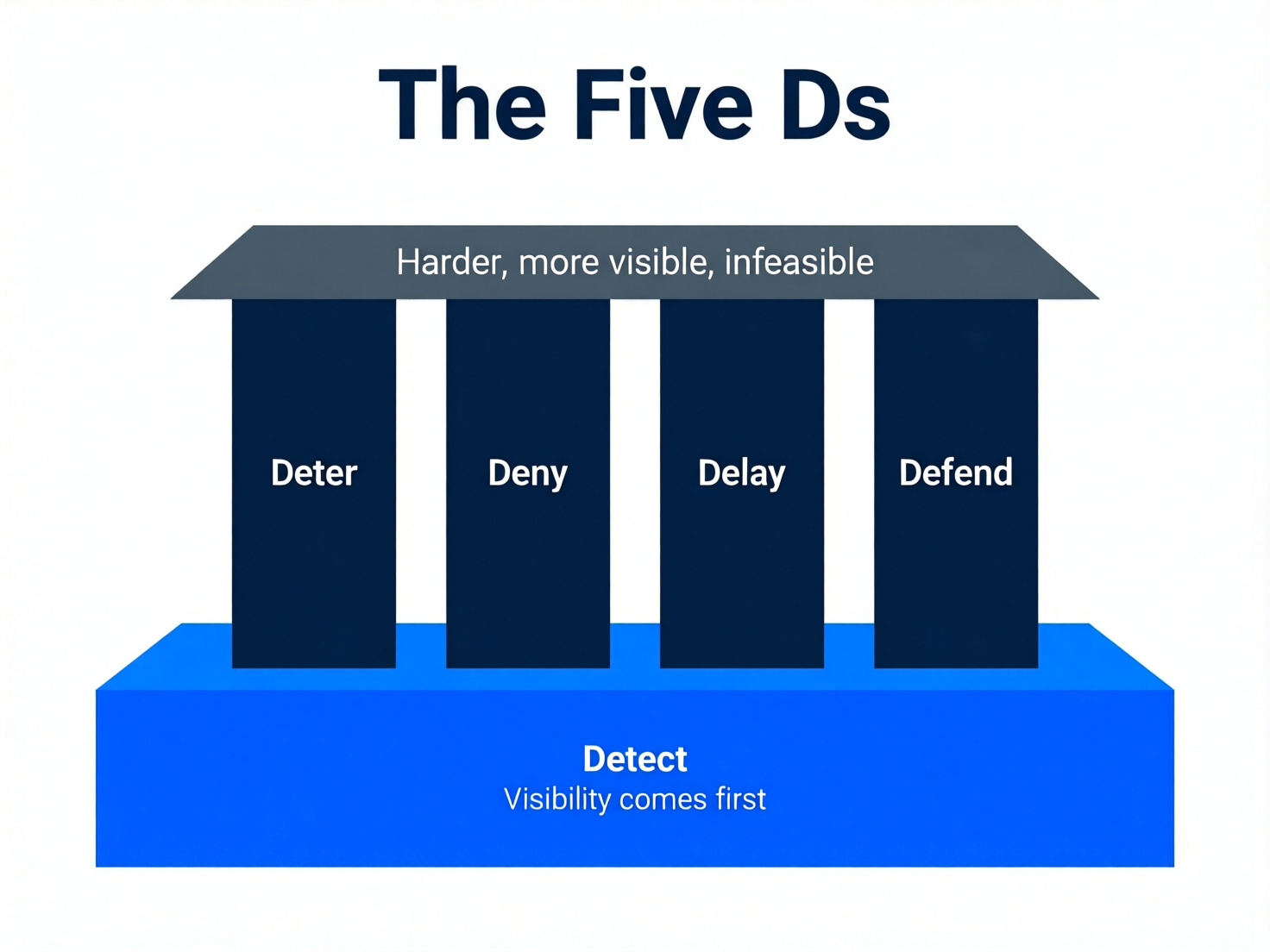
The Five Ds drawn as a structure, with Detect as the foundation and Deter, Deny, Delay and Defend standing on it
Detection carries the other four. An organisation that cannot see its conditions change cannot deter, deny, delay or defend against what follows.
Making quantum readiness measurable
This is where QUANTA moves beyond being a collection of controls.
The 40-control framework is linked to a quantitative assessment layer through QES, CAS and TRS.
- QES addresses technical cryptographic exposure.
- CAS examines architectural and cryptographic agility.
- TRS assesses governance and the organisation's preparedness to execute a post-quantum transition.
In the underlying model, QES corresponds to controls 1–15, CAS to controls 16–28 and TRS to controls 29–40.
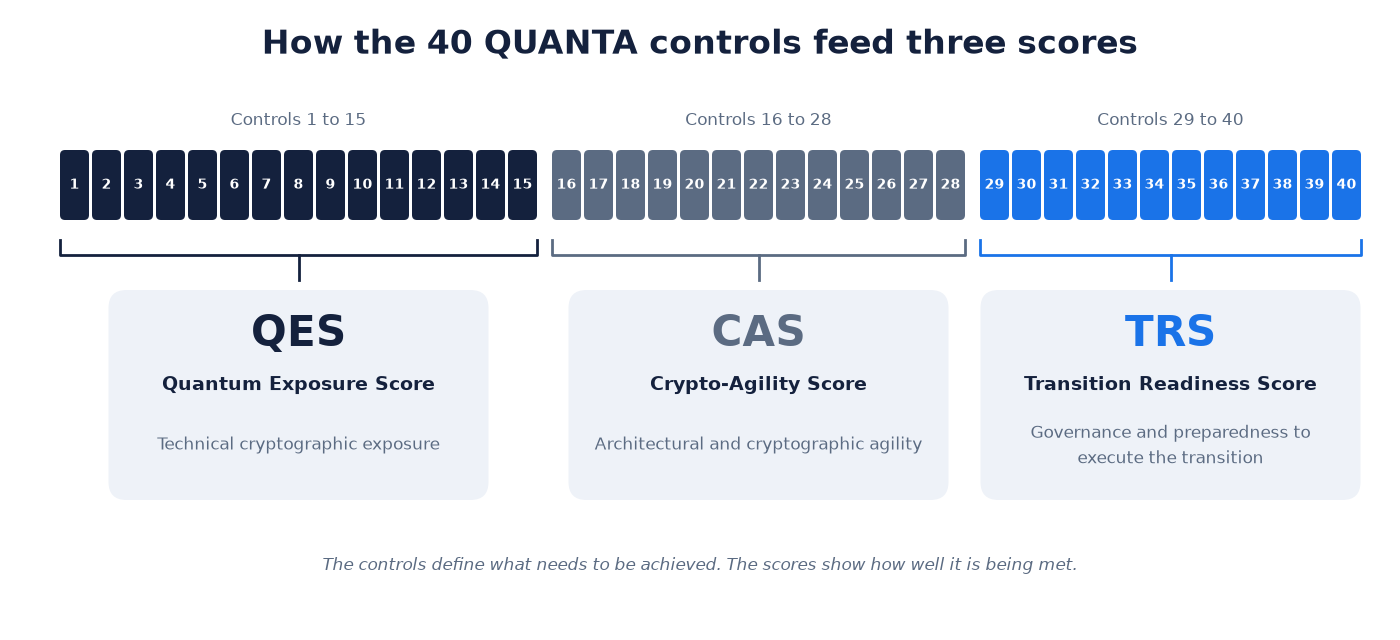
The 40 QUANTA controls grouped into three scores, controls 1 to 15 feeding the Quantum Exposure Score, 16 to 28 the Crypto-Agility Score and 29 to 40 the Transition Readiness Score
Every control feeds exactly one score. Exposure, agility and readiness can then be tracked separately rather than blurred into one number.
The controls define what needs to be achieved. The scoring model provides a way of assessing how effectively those requirements are being met. That distinction matters to GRC practitioners because it allows quantum security to become something which can be assessed, monitored and improved rather than remaining an abstract technology risk.
You don't need to predict Q-Day to start
Perhaps the biggest mistake organisations can make is believing that quantum-security planning starts when quantum computers become powerful enough to threaten production cryptography.
By that point, discovering cryptographic assets, redesigning legacy systems, negotiating supplier changes and building crypto-agility into architectures becomes a race against time.
QUANTA takes a different position.
- Manage what you can see today.
- Understand the data.
- Understand the cryptography.
- Understand the architecture.
- Understand the dependencies.
- Understand your ability to change.
Then build a transition programme around the areas where the combination of exposure and fragility matters most. The aim is not to predict the future perfectly. It is to avoid being surprised by it. Ultimately this is what QUANTA to achieve: turning quantum security from an interesting future technology discussion into a security architecture, risk and governance problem that organisations can start managing now.
Run your GRC programme in your own network.
RaptorGRC Community Edition is free: every module, offline licence activation, nothing phones home.
Register / Download Contact us