BLOG
Segregation of Duties Outside Finance
Published 16 November 2026 · By P Larner
Security in Practice#change management#access control#segregation of duties#ISO 27001#privileged access#audit logging#small teams

Illustration for: Segregation of Duties Outside Finance
No finance director would let the person who sets up a supplier also approve the payment to it. The control is centuries old, it is understood by every auditor alive, and nobody argues about it. Then the same organisation gives a single engineer the ability to write code, approve their own change, deploy it to production and delete the log that recorded them doing so, and calls it efficiency.
Segregation of duties is the best understood control in business and one of the least applied in technology. This post is about where it belongs outside finance, how to implement it without hiring people you do not have, and how to be honest when you genuinely cannot.
What the control actually does
Segregation of duties splits a sensitive activity so that no single person can complete it alone. It is not about trust and it is not an accusation. It exists because a single person acting alone can make a mistake nobody catches, or can be compelled by someone else, or occasionally can act deliberately, and one control addresses all three.
The distinction worth holding is between segregation and simple approval. An approval step where the approver has no realistic ability to disagree is not segregation, it is a signature. The control only works where the second person has the information, the standing and the incentive to say no.
The pairs that matter in technology
Finance has a canonical list of incompatible duties. Technology has one too, and it is rarely written down.
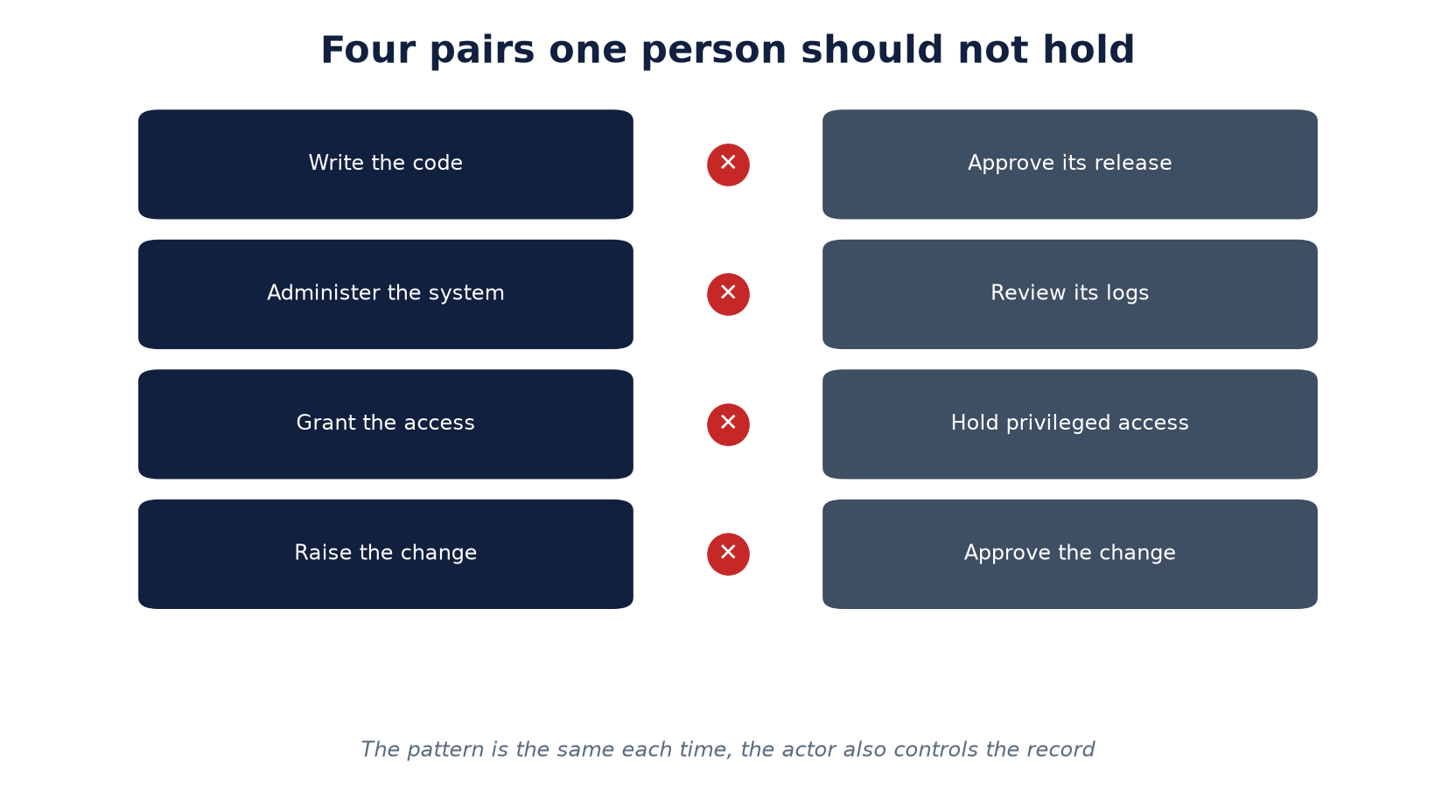
Diagram of four incompatible duty pairs in technology
Four pairs where one person holding both ends removes the only check on the activity. The pattern is always the same, which is that the actor also controls the record of the action.
Writing code and approving its release
The most common breach, and the easiest to fix. Code review by somebody other than the author is now normal practice, and where it is enforced by tooling rather than convention it is genuine segregation.
The exception that swallows the rule is the emergency deployment path, which usually allows a single named person to push directly. That path is legitimate and it needs its own control, which is that every use is logged, reviewed after the fact by somebody else, and rare enough that a rise in frequency is visible.
Administering a system and reviewing its logs
If the person who can change a configuration is also the person who can edit or delete the record of that change, there is no audit trail, only a story. This is the pair organisations most often miss because both activities feel like the same job.
The fix is architectural rather than organisational. Forward logs to somewhere the administrator cannot alter, and give log review to a different team. Neither requires more headcount, only a decision.
Granting access and holding privileged access
The administrator who can create accounts can create one for themselves. Where the identity platform allows it, access grants should require a second approval, and privileged access should be time bound rather than standing, so that the window in which a self-granted right is useful is short and visible.
Raising a change and approving it
Change advisory boards exist partly for this, and they have a well known failure mode where the board approves everything presented to it. A board that has never rejected a change is not providing segregation, and it would be more honest to automate the approval and put the effort into peer review instead.
The small team problem
Every article about segregation of duties assumes an organisation with enough people. Most do not have that, and pretending otherwise produces policies that are ignored on day one.
The honest position is that in a team of three, full segregation of every sensitive activity is impossible. What is possible is a graded response, and it works in a specific order.
First, separate what you can without headcount. The engineer can deploy, but the logs go somewhere they cannot reach. That is a real control and it costs nothing but configuration.
Second, use people outside the team. A second pair of eyes does not have to be a second specialist. A finance manager can confirm that a payment change was requested by the right person without understanding the system. A director can review a list of privileged access grants monthly and ask why there are more than last month.
Third, substitute detection for prevention. Where you cannot stop one person doing something alone, make sure somebody independent sees that they did. Alerting on privileged actions to a person outside the team is weaker than prevention and vastly better than nothing.
Fourth, document the residual risk and have it accepted by name. A small organisation that has written down that its lead engineer holds incompatible duties, listed the compensating controls, and had a director accept it with a review date, is in a defensible position. One that has a policy claiming segregation it does not have is in a worse position than if it had no policy at all.
Finding the breaches you already have
Most organisations discover their segregation problems during an audit. Finding them yourself is not difficult, and it starts from activities rather than from job titles.
Take your five most sensitive activities. Payment changes, privileged access grants, production deployment, log configuration and customer data export is a reasonable starting set for most organisations. For each one, list every person who could complete it end to end without needing anybody else. That list is your exposure, and it is usually longer than expected because it includes people who hold the ability without ever using it.
Two traps make the list longer than the org chart suggests. Emergency access procedures often grant one person everything, and they are frequently untested and unmonitored. And group membership accumulates through role changes, so the person who moved from infrastructure to development three years ago may still hold both sets of rights. An earlier post in this series makes the same point about movers being the expensive case in access reviews.
Making it stick
Segregation decays quietly, because every individual exception is reasonable at the time. Three habits keep it in place.
Review the incompatible pairs rather than the access lists. Reviewing everybody’s access annually finds excess permissions. Reviewing the specific question of who can complete each sensitive activity alone finds the control failures, and it is a much shorter exercise.
Handle exceptions formally and temporarily. Somebody will need both halves during an incident or a departure. Grant it, time bound it, log it and take it back, and make the taking back automatic rather than dependent on somebody remembering.
Include it in change design. The cheapest moment to build segregation into a process is while the process is being designed, and the most expensive is after an auditor has written it up.
The honest counterarguments
It slows everything down
Sometimes it does, and the honest response is to be selective rather than to deny it. Segregation applied to every activity in a technology estate would be intolerable and would be routed around within a month. Applied to a small number of genuinely sensitive activities, the cost is modest and the routing around does not happen. The discipline is choosing the short list rather than applying the principle everywhere.
Modern practice has moved past it
The argument is that automated pipelines, infrastructure as code and immutable deployment make human segregation obsolete because the machine enforces the rules. There is something to this, and it relocates the control rather than removing it. The question simply becomes who can change the pipeline, and if one person can alter the pipeline that enforces the separation, the separation is nominal. Segregation of duties applies to the control plane exactly as it applied to the process.
It implies you do not trust your staff
This objection comes up in small organisations and it deserves a straight answer rather than a defensive one. The control is not a judgement about individuals, it is protection for them. A person who cannot complete a fraudulent or catastrophic action alone also cannot be accused of having done so, and cannot be pressured into it by anyone outside the organisation. Framed that way, most people stop objecting.
Common mistakes
Segregating on paper through job descriptions while the access rights say something different. The system is the source of truth and the description is a wish.
Treating approval as segregation when the approver cannot realistically refuse. A rubber stamp is a delay, not a control.
Forgetting service accounts and automation. A pipeline account with both build and deploy rights is one person, if one person holds its credentials.
Applying it only to production. Test environments holding real customer data need the same treatment, and they usually have looser access precisely because they are considered less important.
Writing a policy the organisation cannot meet, and then reporting compliance with it. This is the failure that turns a control weakness into a credibility problem.
Where to start
Pick your single most sensitive activity, whichever one would cause the most damage if performed maliciously or by mistake, and list everyone who could do it end to end alone. Do not guess from the org chart, check the actual permissions.
If that list has more than one name on it and no compensating detection, you have found something worth fixing this month. If it has exactly one name and no second pair of eyes, you have found something worth accepting formally, with a director’s signature and a review date. Either outcome is progress, and both are considerably better than the position most organisations are in, which is not knowing the answer at all.
Written by P Larner. Drafting and copy-editing were assisted by AI tools, and header images are AI-generated. All technical claims are the author's.
Run your GRC programme in your own network.
RaptorGRC Community Edition is free: every module, offline licence activation, nothing phones home.
Register / Download Contact us